Jet Ski and PWC Fenders: Why Standard Boat Bumpers Don’t Fit and What Actually Works
If you’ve ever tied a personal watercraft — a Jet Ski, Sea-Doo, WaveRunner, or any of the sit-on-top watercraft in that category — to a dock and just grabbed a couple of the cylindrical rubber bumpers you already had lying around, you’ve probably noticed the problem. The bumper rolls away, the hull still rubs the dock edge, and you come back to a scuffed gel coat that costs real money to fix. Those cylindrical bumpers (the inflatable or foam tubes that hang between a boat and a dock to absorb contact) were sized and shaped for displacement boat hulls — the deeper, more vertical hull sides on a traditional powerboat or sailboat. PWC hulls are shallower, wider at the waterline, and flare outward in ways that cause standard fenders to slip right past them. This guide explains the geometry problem in plain terms, walks through what the market actually offers, shows you the math on protection vs. cost, and closes with a clear decision framework depending on your dock type.
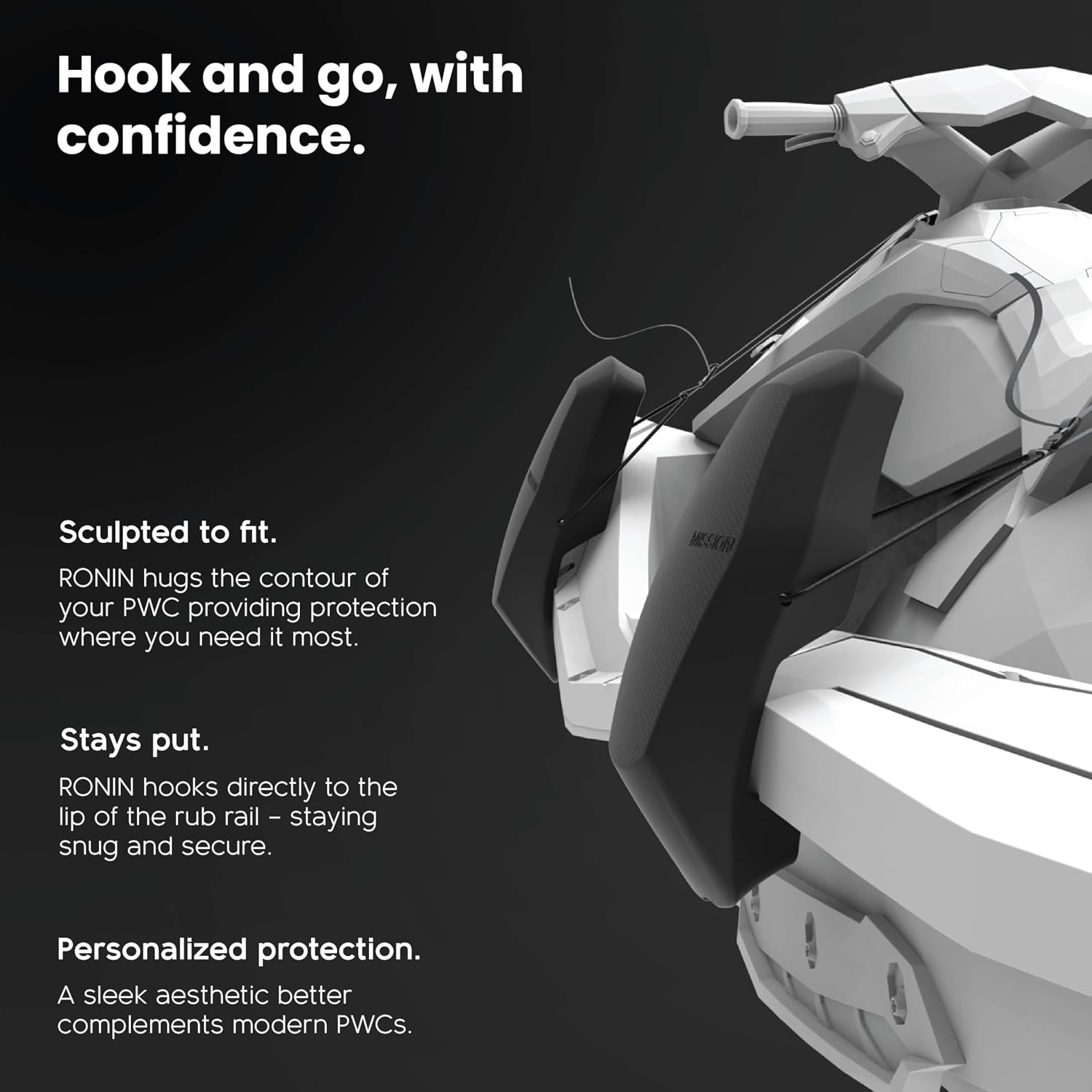
| EDITOR'S PICK[AWEMUFA Boat Fenders Easy to In…](https://www.amazon.com/dp/B0GBSYPPTT?tag=greenflower20-20) | Mid-tier[MISSION Boat Gear Ronin PWC Fen…](https://www.amazon.com/dp/B0CXTPWM25?tag=greenflower20-20) | Budget pick[Affordura PWC Fender Bumper wit…](https://www.amazon.com/dp/B08PVDXWNG?tag=greenflower20-20) | |
|---|---|---|---|
| Type | Boat fenders | PWC fenders | PWC fender bumper |
| Size | XL | — | 18.5" |
| Mounting | — | Knotless strap | Elastic cords |
| Price | $129.99 | $119.00 | $39.99 |
| See on Amazon → | See on Amazon → | See on Amazon → |
Why the Geometry Mismatch Is a Real Problem (Not Just a Marketing Angle)
A standard cylindrical boat fender — the style most dock owners already have — is designed to compress between a flat or gently curved vertical hull side and a dock face. It works because the hull provides a flat “wall” to hold the fender in place under lateral pressure. PWC hulls don’t cooperate with this geometry for two reasons:
1. The hull flare. Most PWC hulls have a pronounced outward flare above the waterline. When you hang a cylindrical fender on a dock cleat and push a Sea-Doo against it, the hull’s curved underside meets the round fender at an angle, giving the fender almost no surface area to grip. The fender either rolls upward and over the gunwale edge or drops below the hull entirely.
2. The low freeboard. “Freeboard” is the distance from the waterline to the top edge of the hull. PWCs sit very low — typically 8 to 14 inches of freeboard depending on model and load — compared to 18 to 36 inches on a typical runabout. That means the contact zone between hull and dock is compressed into a narrow band, and a standard fender sized for a larger boat just overshoots that band vertically.
Practical Sailor’s fender materials roundup notes that fender sizing is the single most common source of gel coat damage in marina environments, and the spec guidance they cite is explicitly built around displacement-hull geometry. PWC owners are working outside that design envelope entirely.
The consequence isn’t just cosmetic. PWC hulls are typically injection-molded high-density polyethylene (HDPE) or fiberglass-reinforced plastic, and a dock edge — especially a pressure-treated wood edge, an aluminum extrusion corner, or a concrete seawall cap — concentrates force into a very small contact patch. Repeated contact without proper fender coverage causes stress cracking and delamination in fiberglass models, and surface abrasion that weakens structural integrity over time in HDPE hulls.
The Four Fender Categories That Actually Work for PWCs
Once you understand why standard cylindrical fenders fail, the alternatives make immediate sense. Here’s how each category performs against the geometry problem.
1. PWC-Specific Flat Dock Bumpers (Foam-Core or EVA-Foam)
These are wide, flat or gently curved foam panels — typically 12 to 48 inches long — designed to mount flush to the face of a dock or seawall, rather than hanging from a cleat. Because they cover a broad vertical surface rather than presenting a single round contact point, they work with the PWC hull’s flare instead of against it. The hull touches the foam panel across a wide area, distributing force and preventing point-load damage.
EVA foam (ethylene-vinyl acetate — the same closed-cell foam used in boat flooring and paddle board surfaces) is the dominant material in this category. It’s UV-stable, doesn’t absorb water, and maintains its compression recovery over multiple seasons. Owners in aggregated reviews consistently note that EVA foam panels hold their shape far longer than open-cell foam alternatives, which compress permanently after one season of heavy use.
Installation note: Most mount via stainless or galvanized lag screws directly into dock framing. Budget for stainless hardware if you’re in a saltwater or brackish environment — zinc-plated screws will bleed rust onto the foam face within one season.
2. PWC Port Systems (Integrated Roller-and-Bumper Docks)
A PWC port — sometimes called a drive-on port or boarding platform — is a floating or fixed dock section designed specifically for a personal watercraft to drive onto bow-first and rest on rollers or a padded cradle. The bumper function is built into the port itself: the hull never contacts a dock edge because it’s cradled from below. Brands like Connect-A-Dock, Perma-Float, and Jet Dock build systems in this category.
The tradeoff is cost and fixed installation. A quality PWC port runs $1,200 to $3,500 depending on configuration, versus $40 to $300 for a set of flat foam bumpers. For property owners who dock the same PWC daily or keep it in the water seasonally, the math often favors the port system — it eliminates fender management entirely, keeps the hull off the water for anti-fouling purposes, and significantly reduces wear on the hull’s underside. Boating Magazine’s PWC dock accessories coverage describes the drive-on port as the “set it and forget it” option for owners who prioritize hull preservation over upfront cost.
For a second or guest PWC that docks occasionally, flat bumpers are usually the right call.
3. Corner Bumpers and Edge Guards
If your PWC docks in a slip with fixed dock edges — aluminum extrusion corners are the most aggressive offenders — corner bumpers provide targeted protection at the highest-risk contact points. These are typically L-shaped or curved vinyl or rubber extrusions that cap the dock edge and present a rounded, compressible surface to the hull.
They’re inexpensive ($15 to $60 per linear foot depending on material grade) and easy to retrofit. The limitation: they protect the dock edge, but they don’t provide the broad-coverage hull protection that a flat foam panel does. Use them as a supplement, not a standalone solution, if your PWC has significant lateral movement in its slip.
4. Floating Bumper Logs (Foam-Filled)
Foam-filled floating bumper logs — large cylindrical floats, typically 4 to 8 inches in diameter and 4 to 6 feet long — provide a cushioned barrier between a PWC and a dock face when suspended at hull height. Unlike inflatable cylindrical fenders (which deflate and lose their position), foam-filled logs maintain consistent buoyancy and stay at a predictable height relative to the waterline.
The catch: they still present the same cylindrical surface problem with flared PWC hulls, just with more surface area. Power & Motoryacht’s dock bumper guidance notes that foam logs perform best on boat hulls with more vertical topsides; for PWCs, they’re a better-than-nothing solution for temporary or guest docking, not a primary protection strategy.
By the Numbers
| Solution | Typical Cost | Coverage Area | Best Fit |
|---|---|---|---|
| EVA flat dock bumper panel | $40–$180 | Broad hull surface | Daily docking, any PWC type |
| PWC drive-on port system | $1,200–$3,500 | Full hull cradle | Seasonal / daily owner |
| Corner edge guard (vinyl) | $15–$60/ft | High-risk dock corners | Retrofit supplement |
| Foam bumper log (float) | $35–$120 | Narrow contact band | Temporary / guest docking |
Material Grade: What to Specify for Freshwater vs. Saltwater
This is where intermediate buyers often leave money on the table. The bumper that holds up fine on a freshwater lake for four seasons may fail noticeably faster in a saltwater or brackish environment. The degradation mechanisms differ:
Freshwater: UV exposure and freeze-thaw cycling are the primary material stressors. EVA foam holds up well; look for panels with a UV-inhibited outer skin rather than raw foam. Hardware should be 304 stainless minimum — galvanic corrosion isn’t a significant factor in freshwater, so the cost premium of 316 stainless isn’t usually justified for freshwater dock hardware.
Saltwater / brackish: Salt accelerates corrosion on any ferrous or lower-grade stainless hardware. Specify 316 stainless for all mounting screws and backing plates — the difference in upfront cost is $5 to $15 per mounting point, and it’s trivially worth it to avoid replacing corroded fasteners that have bled rust stains into the foam face and dock decking. The foam material itself (EVA or closed-cell polyethylene) is salt-neutral, so material selection on the bumper body matters less than the hardware spec.
If you’re mounting to an aluminum dock frame, use a neoprene or rubber gasket between the stainless hardware and the aluminum surface to prevent galvanic corrosion (the electrochemical reaction that occurs when dissimilar metals contact each other in a salt-water electrolyte environment). This is a spec detail that matters much more at the dock level than most installation guides address.
The Decision Framework: If X, Then Y
You’re buying for a specific situation, so here’s the explicit decision tree:
If your PWC is docked daily at a fixed dock and you own it long-term: Price a PWC port system seriously. The $1,200–$3,500 spend is front-loaded, but it eliminates recurring fender management, protects the hull’s full underside, and increases resale appeal of the dock setup itself. At two or three seasons of avoided hull repairs, the math typically closes.
If your PWC is seasonal or docks a few times a week: Go with EVA flat foam bumper panels sized to your dock face. Aim for full-length coverage of the slip’s contact side rather than individual spot bumpers. Budget $80–$180 for a quality panel set, add 316 stainless mounting hardware in saltwater environments, and you have a solution that’s good for three to five seasons with no management overhead.
If you have a shared dock, HOA seawall, or guest PWC situation: Corner edge guards on high-risk dock corners plus one or two foam bumper logs deployed at hull height give you flexible, low-cost protection that doesn’t require permanent mounting. This is also the right answer for marina slip use where you can’t modify the fixed infrastructure.
If your dock has sharp aluminum extrusion edges regardless of which category above applies: Add corner edge guards as a supplement. They’re inexpensive insurance against the one failure mode that every other fender type is slow to address.
The geometry problem is real, but it’s also solvable with products that already exist and are priced accessibly at every tier. The mistake most owners make is defaulting to boat hardware for a PWC application without questioning whether the underlying design assumptions match. They don’t — but now you know exactly what to reach for instead.