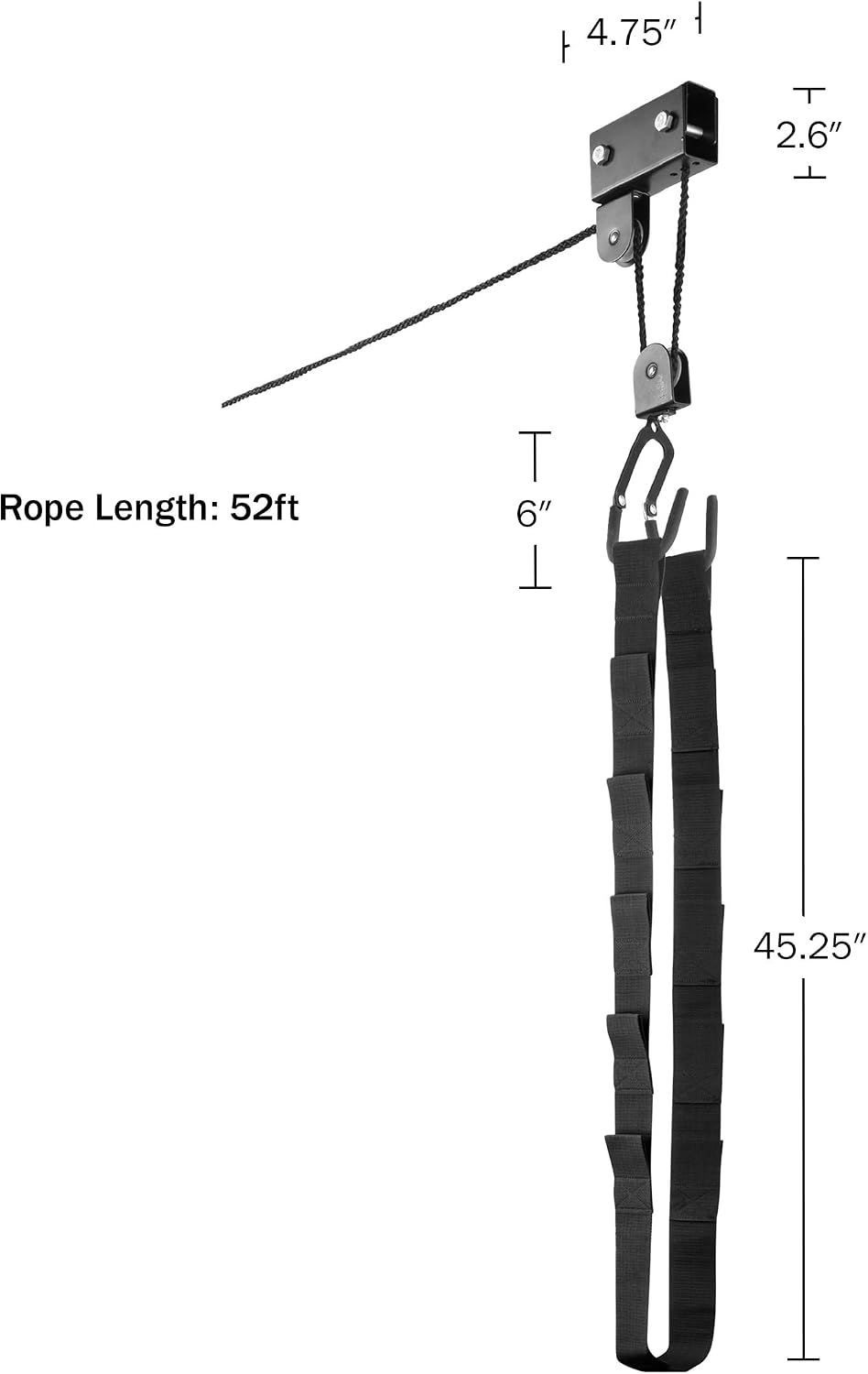
If you’ve ever wrestled a 55-pound kayak — the long, narrow paddle-powered boat — off a garage floor or tried to lower one into the water alone without scratching it or losing your footing, you already know why people start searching for a better system. An overhead hoist is exactly what it sounds like: a pulley-and-rope mechanism you mount to a ceiling or overhead beam that lets you crank your kayak or canoe up into the air for storage, then lower it back down when you’re ready to use it. A kayak launch station is a different animal — it’s a dock-mounted cradle or rail system that holds your boat horizontally at dock level so you can slide into it safely from the dock, rather than stepping down into a rocking hull from a standing position. Both products solve real problems, but they solve different problems. Conflating them — buying one when you need the other — is the most common expensive mistake in this category.
This article breaks down what verified owners are reporting after installation, where each product earns its price, and where the rough edges are. We draw on aggregated owner reviews, published load specifications from manufacturers, and editorial analysis from sources including Wirecutter’s kayak storage coverage, This Old House’s overhead storage guides, Boating Magazine’s dock accessories reporting, and Practical Sailor’s rope-and-pulley load-rating explainers. No in-house testing — just pattern recognition across real-world owner feedback.
The Overhead Pulley Hoist: What RAD Sportz Owners Are Actually Saying
The RAD Sportz overhead kayak hoist has accumulated enough owner reviews to show clear patterns — both positive and negative — that go beyond the usual five-star/one-star noise.
What owners praise consistently:
The double-rope pull mechanism is the feature owners come back to most. In single-rope systems, you’re pulling the full weight of the boat with one line, which means a 60-pound loaded kayak requires 60 pounds of sustained pulling force. The RAD Sportz double-rope design mechanically halves that effort — you’re lifting the same weight with roughly half the perceived pull. Owners across review aggregations describe this as “dramatically easier” versus systems they’d used before, and several mention elderly or smaller-framed household members being able to operate the hoist independently for the first time. That’s a real-world quality-of-life shift, not a marginal spec improvement.
The industrial hook quality earns separate mention in reviews — owners specifically call out that it doesn’t feel cheap, which matters when you’re hanging a $1,200 composite kayak six feet in the air. Strap strength draws similar commentary: no fraying reports in normal use, and the straps seat against hull contact points without leaving pressure marks on plastic or fiberglass hulls, per owner accounts.
The brake mechanism — the spring-loaded cam that locks the rope and holds the load in place — holds well without the “creaking” or “slipping” noise owners report with lower-cost competitors. Multiple reviewers specifically tested this by leaving a loaded kayak suspended overnight and returning to find it exactly where they left it. More on overnight hold in the FAQ section below.
The ceiling height question:
This is where you need to do the math before you buy. Your kayak is typically 17–28 inches deep when cradled in straps. Add the strap hang length, the pulley clearance, and the clearance you need to slide the boat horizontally out of its cradle, and you’re looking at a practical minimum ceiling height. Owners report that 8-foot ceilings are workable but tight — you’ll be able to store the kayak, but loading and unloading requires some maneuvering. Owners with 10-foot or higher ceilings consistently report the system works without friction. We’d flag 8 feet as a functional minimum, not a comfortable one.
By the Numbers — RAD Sportz Hoist
| Spec | Published Rating |
|---|---|
| Maximum rated load | 125 lbs |
| Rope system | Double-pull (2:1 mechanical advantage) |
| Recommended ceiling height | 9 ft minimum (manufacturer) |
| Solo installation | Yes — owners report ~45 min with a drill |
The Kayak Launch Station: The Emotional Case and the Real Problems
The kayak launch station (the dock-mounted cradle system) generates a different kind of owner review — more emotionally invested, which is actually meaningful data. One owner, in a frequently cited review, explicitly frames the product as a life-quality change: they went from kayaking once or twice a month to several times a week after installation, specifically because the physical barrier of getting into and out of the water had been removed. That’s the kind of outcome that justifies a hardware purchase.
The mechanism here isn’t about storage — it’s about safe water entry and exit. Instead of standing on a dock edge and trying to step down into a floating hull (which rocks, which is how people fall), the launch station holds the kayak stable and level at dock height, so you sit into it on solid ground, then push off. For older paddlers, anyone with balance concerns, or anyone who paddles solo, this isn’t a luxury feature. It’s the difference between using the boat and not using it.
The two problems owners name concretely:
Problem 1: No instructions, no parts list. Multiple owners report the unit arriving with zero documentation in the box — no assembly guide, no hardware inventory, no parts callout diagram. For a product with multiple mounting components and adjustable cradle arms, this is a genuine frustration. Owners report having to work through assembly by intuition or by finding community forum threads. This is a fixable problem (the assembly is logical once you’re in it), but it adds 30–60 minutes of friction to an installation that should be straightforward.
Problem 2: Bowing. This is the more significant issue. Several reviewers report the unit arriving with a visible bow — the main rail or cradle platform warped enough to be immediately noticeable. One owner describes laying the unit flat on pavers in full sun for a week to allow the material to relax and straighten. That worked in their case, but it requires you to have that time, that space, and patience. If you’re buying for a season opener weekend, this timeline is a problem.
We cover both issues in the FAQ section with practical workarounds.
The floating dock requirement:
The launch station’s function depends on the dock surface being near water level — typically 3–6 inches above the waterline. That’s the profile of a floating dock (a dock that rises and falls with the water level, kept level by flotation billets). A fixed dock — one bolted to permanent pilings at a set height — may sit 18–36 inches above the waterline depending on the lake’s fluctuation range and the dock’s original design. At that height, the launch station’s cradle geometry doesn’t work as intended; you’re still stepping down a significant distance. Owners on floating docks are overwhelmingly positive. Owners who discovered after purchase that their fixed dock doesn’t fit the spec are not. Verify your dock type and freeboard (the distance from dock surface to water) before ordering.
How These Two Products Fit a Dock System — and When to Buy Which
These are complementary tools, not competing ones. If you’re designing a complete paddle-sports setup for a dock property, the decision framework looks like this:
Storage problem (boat is in the way, taking up floor space, or living outside): The overhead hoist is your tool. It works in garages, under deck overhangs, in boathouses, and in any covered structure with a load-bearing overhead member. The RAD Sportz double-rope system earns its position as the category’s practical leader based on consistent owner feedback on mechanism ease and brake reliability.
Access problem (getting in and out of the water is hard, scary, or inconsistent): The launch station is your tool — provided you have a floating dock with appropriate freeboard. If you have a fixed dock, solve the freeboard problem first (some owners add floating dock sections specifically for this purpose) or look at alternative gangway and boarding solutions.
Both problems: Buy both. They don’t overlap in function. The hoist stores the boat when it’s not in use; the launch station gets you safely into the water when it is.
As Boating Magazine’s dock accessories coverage notes, the biggest category mistakes happen when buyers optimize for one problem without diagnosing whether they have one problem or two.
Frequently Asked Questions
Can one person install the overhead pulley hoist without help?
Yes, based on owner reports — but with a caveat. The pulley mounting hardware goes up solo without much trouble (owners report roughly 45 minutes with a drill and the right bit for your ceiling material). The trickier part is getting the kayak into the straps the first time to calibrate height, which is easier with a second person steadying the hull. Subsequent uses are fully solo-operable.
What is the actual usable weight limit when you factor in paddle and gear?
The RAD Sportz hoist is manufacturer-rated at 125 lbs. A typical recreational kayak runs 35–65 lbs; a loaded touring kayak with sealed gear compartments can push 80–90 lbs. Owners report using the hoist with gear in the hull (PFDs, paddles, dry bags), and the brake holds without issue. Practical Sailor’s rope-and-pulley load-rating guidance recommends staying at or below 80% of rated capacity for sustained loads — that puts your practical ceiling at around 100 lbs. If your loaded boat-plus-gear combination approaches that, stow the heavy gear separately before hoisting.
Does the kayak launch station work on fixed docks or only floating docks?
Floating docks only, in practical terms. The station is designed for a dock surface that sits close to the waterline. Fixed docks with freeboard greater than roughly 8–10 inches above the water surface won’t allow the cradle geometry to function as intended. Verify your dock type before purchasing.
How do I fix the bowing issue if my launch station arrives warped?
Owners who’ve successfully corrected this describe two approaches: (1) Lay the unit flat on a hard, level surface — concrete pavers work well — in direct sun. Heat relaxes the material, and gravity does the rest over several days to a week. (2) Lay it flat with weight distributed evenly across the bowed section. One reviewer used sandbags. Both methods are reported as effective; the sun-and-pavers approach is most commonly cited. If the bow is severe enough that neither works, document it immediately on delivery for a warranty or return claim.
Will the hoist brake hold a loaded kayak overnight without slipping?
Owner reports are consistently yes. Multiple reviewers specifically describe leaving the boat suspended for extended periods — overnight and longer — and returning to find no movement. The spring-cam brake mechanism in the RAD Sportz hoist draws specific praise for holding quietly without the creaking or incremental slippage owners report in lower-cost competitors. This Old House’s overhead storage guides note that any rope-cam brake system should be inspected annually for rope fraying at the cam contact point — good practice regardless of brand.
What ceiling height do I need minimum for the pulley system to be practical?
Manufacturer guidance puts the minimum at 9 feet. Owner reports broadly support 9–10 feet as the workable floor, with 10+ feet described as comfortable. At 8 feet, it is technically possible to store a kayak, but you’ll have limited clearance for loading and unloading the hull into the straps — owners in this range describe it as “manageable, not convenient.” If your garage ceiling is a standard 8 feet and you can’t modify it, factor that friction into your decision.
The Bottom Line
If your kayak is living on the floor and you have a ceiling with a load-bearing joist, the RAD Sportz overhead hoist is the category’s clearest recommendation based on aggregated owner feedback — the double-rope mechanism alone separates it from single-rope competitors for anyone lifting 50 lbs or more. The brake reliability and hook quality add up to a system owners trust for long-term, unattended storage.
The kayak launch station is a different kind of investment — one with a higher emotional payoff for the right buyer. The owner who went from paddling twice a month to several times a week is a real outcome from real hardware. But it requires a floating dock, patience for potential bowing correction, and tolerance for a documentation gap on installation. If you have the dock setup and can absorb those friction points, owners say it changes how often they actually get on the water.
If X is a storage problem in a garage or covered structure with 9+ foot ceilings, the hoist is your answer. If X is a water-entry access problem on a floating dock, the launch station is your answer. If X is both, they work together without overlap — and that’s a dock setup worth building.