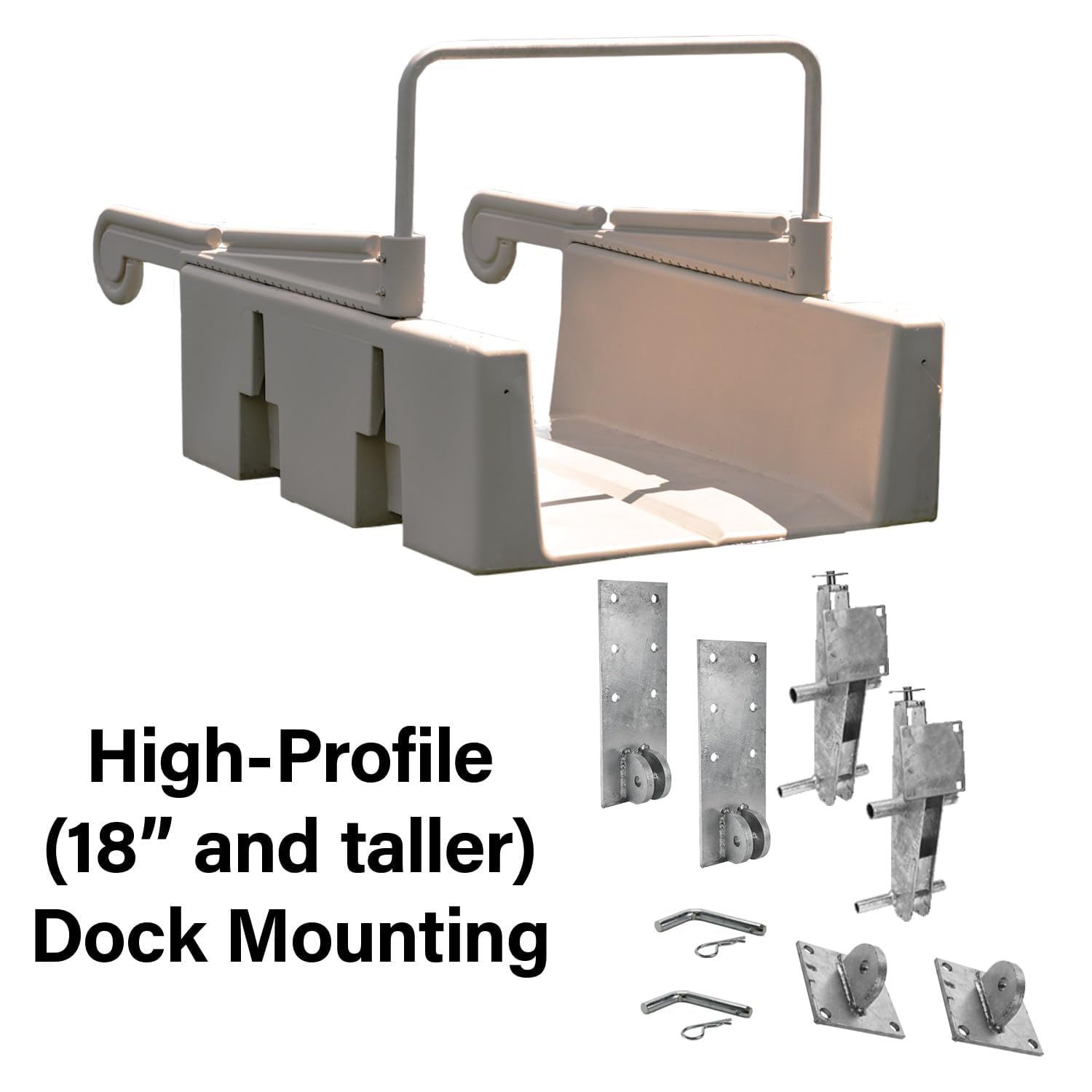
If you’ve ever lowered a 50-pound kayak — that long, narrow boat people paddle while seated close to the waterline — off the edge of a fixed dock while trying not to fall in yourself, you already know the problem. The dock sits anywhere from one to four feet above the water’s surface. The boat wants to slide, tip, or scrape. You end up doing an awkward squat-and-drop maneuver that’s hard on your lower back and rough on the hull (the outside shell of the boat). Paddleboards — the flat, surfboard-style platforms people stand on and paddle — have the same problem in reverse: they’re lightweight but wide and unwieldy getting back up onto a dock. This guide is for waterfront property owners and dock builders who want a real solution: the right launch hardware, installed the right way, so that getting on the water is a pleasure instead of a project.
| EDITOR'S PICK[Personal Kayak Launch Station t…](https://www.amazon.com/dp/B0CX48HMJS?tag=greenflower20-20) | Mid-tier[Niphean Floating Dock](https://www.amazon.com/dp/B0GQY4VCK3?tag=greenflower20-20) | Budget pick[RAD Sportz Kayak Storage Hoist…](https://www.amazon.com/dp/B06XGMSDCP?tag=greenflower20-20) | |
|---|---|---|---|
| Type | Dock-mounted station | Inflatable dock | Overhead hoist |
| Dimensions | 85x48x50 in | 8×6 ft | — |
| Weight capacity | — | — | 125 lb |
| Non-slip surface | — | ✓ | — |
| Portable/Carry bag | — | ✓ | — |
| Intended use | Kayak/SUP launch | Floating platform | Storage |
| Price | $1,917.27 | $227.99 | $20.34 |
| See on Amazon → | See on Amazon → | See on Amazon → |
Why a Standard Dock Edge Is the Wrong Tool for the Job
Most residential docks are built for boats, not human-powered watercraft. A motorboat owner steps from a dock edge onto a gunwale (the upper rim of the boat’s side) that’s close to dock height. A kayaker is descending nearly to water level, and a paddleboarder needs to either step down to the board or hoist the board up — both moves that put torque on a dock edge that wasn’t designed for them.
The three failure modes that show up repeatedly in owner accounts and dock contractor forums are:
-
Hull abrasion. The kayak or SUP (stand-up paddleboard) scrapes along the dock edge or dock post during launch or retrieval, chewing into the gelcoat (the hard outer finish layer) or the foam core beneath it. On a quality composite or carbon SUP, that’s not a cosmetic issue — it’s structural.
-
Lower-back strain. Without a smooth transition point, most people end up bending at the waist and twisting to lower or lift boats at arm’s length. Physical therapists and ergonomics resources consistently flag this motion pattern as a primary source of dock-related soft-tissue injury.
-
Wet re-entry failure. Getting back onto the dock after paddling — especially if you’ve taken a swim — is a legitimate safety issue. A dock edge with no grab point, no step, and no platform-level landing zone is genuinely difficult for a fatigued paddler.
The fix is layered: dock height management, a purpose-built launch station or side-entry slope, hull protection at contact points, and a ladder or step system that works for re-entry. None of these are exotic. But they’re rarely spec’d together, which is why so many dock owners end up solving each problem piecemeal after something goes wrong.
The Four-Component Framework for a Proper Kayak/SUP Launch
1. The Launch Station (the main event)
A kayak launch dock — sometimes called a boarding float or low-profile launch platform — is a small floating section positioned at water level, hinged or connected to your main dock. The paddler sits on the edge, slides into the boat, and the transition height drops from 18–36 inches to roughly 2–6 inches above the waterline. This is the single highest-impact upgrade available.
By the numbers:
- Standard fixed dock height above water: 18–36 inches
- Low-profile floating launch platform height above water: 2–6 inches
- Typical launch platform footprint: 4×8 ft to 4×12 ft
- Installed cost range (platform + hardware): $600–$2,200 depending on decking material and connector style
The main decision here is whether to go with a modular floating dock extension — systems from AccuDock, ShoreMaster, or Connect-A-Dock are the most commonly specified at the intermediate level — or a fixed low-deck section built into the dock during construction. Floating wins in most applications because it self-adjusts with water level. This matters especially in lake environments where seasonal variation of 1–3 feet is normal.
Per This Old House’s coverage of residential dock additions, the connector hardware between your main dock and a floating launch section should be rated for lateral load, not just vertical — the hinge point takes real stress when a paddler pushes off. Stainless connectors rated to ABYC (American Boat and Yacht Council) standards are the right spec call here.
2. Hull Protection at Contact Points
Wherever boat or board hull contacts the dock — edge, piling, or launch platform corner — you need a sacrificial surface that’s softer than your hull.
Dock edge molding (sometimes called dock edging or dock bumper strip) is a dense foam or rubber extrusion that attaches to the vertical face of the dock. Taylor Made and Dock Edge both manufacture extruded PVC and foam-core variants in 8-foot lengths that run $20–$65 per section depending on profile. The D-profile (shaped like a capital D in cross-section) is the industry standard for edge protection; it compresses under contact pressure without rebounding hard enough to bounce the boat away from the dock.
For launch platforms specifically, owners consistently report that EVA foam decking (ethylene-vinyl acetate — the same closed-cell foam used in athletic shoe soles and yoga mats) outperforms composite or treated wood on the platform surface itself. It’s grippy when wet, warm underfoot, and doesn’t abrade hulls on contact. Most modular floating dock systems offer EVA tile decking as an option or aftermarket upgrade.
Practical Sailor’s material analysis of dock surface durability in freshwater versus coastal salt environments notes that EVA degrades faster under UV exposure without UV inhibitors added to the compound — so verify that any EVA tile product you specify includes UV stabilization. Quality tiles from brands like Teak Isle or Permateak carry this in their published specs.
3. The Re-Entry Ladder
This one gets underspecified more than any other component. Most dock ladders are designed for swimmers coming up from a swim platform — they’re vertical, narrow, and placed at the end of the dock. A paddler returning from a long flat-water session or recovering from a wet exit (a capsize) needs something different:
- Three to four steps minimum below waterline (two is not enough for a person treading water to get foot purchase)
- Step width of at least 20 inches so a paddler can climb with feet apart, not stacked
- Grab rails that extend above dock level so the last step of the climb doesn’t require a pull-up
Garelick’s EEz-In series and Tommy Dockside’s aluminum dock ladders are the most frequently cited in this category at the intermediate price tier. Garelick’s published specs on the EEz-In 4-step model show a 350-lb rated capacity and a 23-inch step width. Tommy Dockside’s heavy-duty aluminum variants are rated similarly and add an articulating hinge design that keeps the bottom step at a consistent angle regardless of lake level change.
For saltwater or brackish water installations, Practical Sailor’s corrosion analysis consistently favors 316 stainless fasteners over 304 stainless and anodized aluminum over bare aluminum in all ladder hardware. The cost delta is real — roughly 25–40% more — but corrosion failures in ladder hardware are a safety issue, not just a maintenance issue.
4. Storage Integration
The last piece of the framework that often gets ignored until after the fact: where do the boats live between uses?
A kayak sitting on the dock is a tripping hazard, a UV-exposure problem, and an invitation to windblown hull damage. The two most practical solutions for residential dock environments are:
- Vertical wall-mount racks on the dock structure or the boathouse wall — StoreYourBoard and Suspenz both make padded cradle systems that hold one or two kayaks vertically, keeping the hull off the deck. Wall-mount systems run $40–$180 per kayak depending on material and padding.
- Dock-mounted horizontal kayak racks — freestanding A-frame or post-mounted designs that hold boats at waist height for easy lifting. These work better when the dock has clear horizontal space. Manufacturers like Shoreline Marine and Malone offer options in the $150–$400 range.
For SUPs, the storage calculus is simpler — they can stand vertically in a dedicated rack slot or hang on padded J-hooks — but the dock surface underfoot still matters. An EVA-decked platform with proper rack mounts treats the equipment better than bare wood or composite.
Freshwater vs. Saltwater: The Material Spec Difference That Actually Matters
If your dock is on a freshwater lake, river, or reservoir, the hardware spec tolerance is more forgiving. Powder-coated aluminum performs well, 304 stainless is generally adequate for cleats and ladder fasteners, and the main enemy is UV degradation of foam and plastic components.
In saltwater or brackish water (mixed salt/fresh, common in tidal estuaries and coastal bays), the game changes. Per Practical Sailor’s corrosion reporting, 304 stainless develops crevice corrosion — pinhole rust forming in hidden seams — within 18–36 months in salt spray environments. The spec call is 316 stainless at every fastener and hardware point, marine-grade anodized aluminum for structural components, and HDPE (high-density polyethylene) or powder-coated aluminum for dock surfaces rather than steel-framed composites.
Boating Magazine’s dock hardware coverage reinforces this point specifically for hardware at or near water level — the splash zone where a launch platform or lower dock section lives is the highest-corrosion zone on any dock structure.
The Decision Framework: If X, Then Y
Here’s how to match solution to situation:
| Your situation | Recommended approach |
|---|---|
| Fixed dock, 24+ inches above water, freshwater lake | Add a 4×8 floating launch platform on a hinged connector + EVA decking + Garelick 4-step ladder |
| Fixed dock, under 18 inches above water, calm conditions | Dock edge molding + wide-step ladder is often sufficient; floating platform optional |
| Saltwater or brackish water | All of the above, but spec 316 stainless hardware throughout; anodized aluminum dock components |
| Heavy-use setup (multiple kayaks, SUPs, family) | Floating launch platform + dedicated storage rack + wider ladder (20”+ step) from day one |
| Retrofit on an existing dock (no rebuild) | EVA foam tile overlay + edge molding + aftermarket ladder replacement — this sequence addresses 80% of the problem for $400–$900 |
Coastal Living’s waterfront property coverage notes that buyers increasingly look at integrated outdoor-water-access features as meaningful property value adds — so the investment case for a proper launch system extends beyond convenience.
What to Budget, and Where Not to Skimp
A fully spec’d launch setup — floating platform, EVA decking, edge protection, proper ladder, and one storage rack — lands in the $1,200–$2,800 range installed in most markets as of mid-2026, depending on your region and whether you’re doing any of the installation yourself. The platform and ladder together are 60–70% of that cost, which is where the safety-critical engineering lives. That’s not where to value-engineer.
The storage rack and edge molding are the areas where mid-range buys hold up well. Owners consistently report that padded cradle designs from StoreYourBoard and Suspenz perform equivalently to more expensive custom-welded alternatives for residential use. The money is better spent on a quality hinge connector for the floating platform and a ladder with a proper weight rating.
If you’re doing this in phases, prioritize in this order: (1) the launch platform or low-entry solution, (2) the ladder, (3) hull protection, (4) storage. Phases one and two are the back-saving, safety-critical work. Phases three and four are how you protect your investment in the boats themselves.