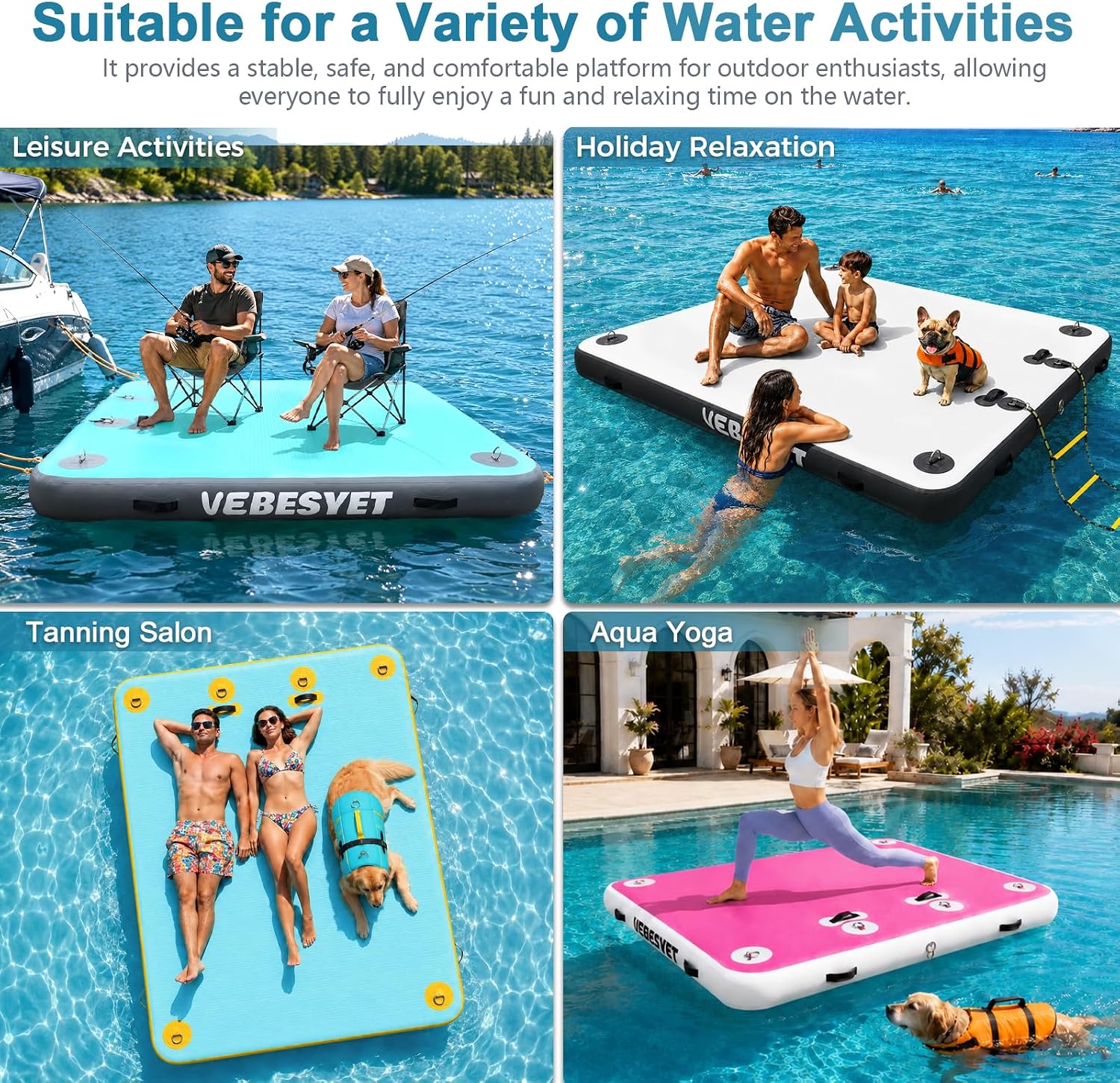
An inflatable floating dock is exactly what it sounds like: a buoyant platform — typically made of drop-stitch PVC (a construction technique that sandwiches hundreds of internal fabric threads between two PVC skins so the panel inflates board-stiff instead of balloon-round) — that floats on the water’s surface and provides a flat standing area. Most models sold for recreational use today come with a water ramp: a gently angled, textured inflatable slope that extends from the platform’s edge down into the water, giving dogs, kids, or tired swimmers a gradual surface to climb back aboard without hauling themselves over a hard ledge. If you’ve watched your 70-pound Labrador scramble unsuccessfully at a dock edge while you tried not to panic, you already understand why this category exists. This guide breaks down the five products that dominate the 2025–2026 market in this space, the real failure modes documented by owners, and a clear decision framework so you buy the right one the first time.
Why the Ramp Is the Feature — and Also the Weakness
The ramp does the most important job in this product category, and it’s also where the most documented failures happen. Understanding that tradeoff before you pick a model is the difference between a platform that lasts three seasons and one you’re returning in September.
The mechanics are simple: the ramp attaches to or is integrated with the platform’s edge, slopes at roughly 20–35 degrees into the water, and uses a grippy textured surface (most commonly etched PVC or a glued-on foam traction layer) to give paws and bare feet purchase on the wet slope. Dogs weighing 40–110 lbs are the primary load case. Most ramps are rated for human use but the attachment hardware — stitching, D-rings, bonded seams — is where stress concentrates.
The most instructive failure in this category comes from aggregated reviews of the Niphean inflatable dock. A reviewer documented ladder rung failure on first use by a 100-pound child, diagnosing neoprene stitching at the rung-to-ramp seam as the structural weak point. That’s a meaningful quality-control flag. Neoprene bonding works well under light, distributed load — it’s why it’s used in wetsuits — but cyclical point-loading from a gripping hand or foot concentrates stress at seam edges in a way that neoprene adhesive handles worse than RF-welded or hot-air-welded PVC seams. Practical Sailor’s coverage of inflatable platform durability notes that hot-air welding at seam junctions outperforms adhesive bonding under repeated wet-load cycling — a spec detail worth asking manufacturers about directly.
The DOK Party-DOK generates the most consistent dog-specific praise with the fewest structural complaints across owner reviews. Reviewers repeatedly describe their dogs self-rescuing without human assistance, and the failure-mode language that shows up in reviews of competing products — rung separation, ramp deflating faster than the platform — is largely absent from the Party-DOK review corpus. If the primary use case is a large or older dog who needs reliable, unsupervised ramp access, the pattern in owner feedback points here more clearly than to any competing model.
The Air Retention Problem: What Owners Actually Experience
Across this product category, the gap between manufacturer claims and real-world owner experience is widest on air retention. Here’s the honest version of that picture.
By the Numbers
- Most manufacturers claim 24–48 hour air retention between top-ups under normal conditions
- Verified one-year air-loss failure documented by a reviewer on the Island Hopper Mega Yacht (three-panel configuration)
- Typical summer temperature swing of 20°F between morning and afternoon can reduce gauge pressure by 10–15% (basic gas law — pressure drops as air cools overnight, spikes as it heats midday)
- Industry standard inflation pressure for drop-stitch platforms: 10–15 PSI depending on panel count and manufacturer rating
The Island Hopper Mega Yacht case is worth dwelling on. A reviewer who purchased the three-panel version and used it through a full season documented meaningful air loss within 12 months — not catastrophic failure, but a platform that required more frequent re-inflation than the product’s positioning suggests. For a platform in this price tier, that’s a realistic concern, not an edge case. The Island Hopper is a legitimate product with a strong brand reputation and a larger, party-appropriate footprint, but buyers should go in expecting to own a quality pump and use it regularly, not treat inflation as a one-time setup step.
Temperature swings are underappreciated. This Old House’s guidance on inflatable dock maintenance notes that morning-to-afternoon pressure variation is one of the most common reasons owners think their platform is leaking when it isn’t. If you inflate to spec at 8 AM when water temperature is 68°F and air is 72°F, then check the platform at 2 PM when the air temperature has hit 92°F, the platform will be noticeably firmer — that’s normal thermal expansion. The reverse is true: a platform that felt perfect at midday will feel slightly soft the following cool morning. Develop a consistent check-and-top-up habit, always in comparable temperature conditions, before concluding you have an actual leak.
Pump Requirements: The Thing Everyone Underestimates
This is the most consistent pattern in owner feedback across every inflatable dock product in this category: buyers underestimate pump requirements, get frustrated, and blame the product when the issue is actually the tool.
The pumps included with most inflatable docks in the $300–$800 price range are hand pumps or low-CFM electric pumps designed to get you to adequate pressure, not to do it quickly or comfortably at 12 PSI across a multi-panel platform. Reviewers at Wirecutter and in aggregated Amazon owner feedback consistently describe included pumps as marginal for anything over a single-panel platform. Here’s the practical translation:
- Single-panel platform (roughly 8x4 ft): Included pump is usually workable. Budget 10–15 minutes of effort.
- Two-panel platform: Included pump gets you there but you’ll feel it. An electric 12V pump with a high-pressure nozzle (look for 20 PSI max output) cuts time to under 5 minutes.
- Three-panel or party configuration: Budget for a dedicated high-pressure electric pump from day one. The included pump is a backup, not a primary tool.
The Beyond Marina introduces a specific and underreported quality-control concern that belongs in any honest buyer’s guide: pressure gauge accuracy. Owner reviews flag situations where the included or recommended gauge reads significantly different from a separately purchased reference gauge at the same valve. At 12 PSI, a 2 PSI measurement error is a 17% variance — enough to mean you’re either under-inflated (soft platform) or over-inflated (stress on seams in heat). If you’re buying the Beyond Marina or any inflatable dock product, invest in a standalone digital tire pressure gauge capable of reading to 20 PSI; they’re inexpensive and eliminate guesswork entirely.
The MoKo Dock and the DIY Modification That Tells You Something
The MoKo inflatable dock surfaces an interesting pattern in owner behavior: a reviewer documented inserting metal rods into the ramp’s step seams to create stiffer, more ladder-like rungs — essentially a field modification to solve a structural softness problem the product didn’t solve out of the box. The ingenuity is real. But the fact that a motivated owner felt compelled to engineer their own solution tells you something about where the product sits on the spectrum.
The MoKo occupies a lower price point in this category, and at that price point it delivers a usable platform. For light-duty use — occasional lake days, small dogs, kids who just want a swim platform — owners report reasonable satisfaction. But the ramp’s grab-ability under load is clearly a concern for heavier users, and that DIY rods modification should be interpreted as a signal: if you have a large dog or a heavy-bodied swimmer who needs to self-rescue reliably, the MoKo is not the product to trust that use case to.
Tethering and Anchoring: What You Actually Need to Know
A question that shows up in owner reviews repeatedly: does an inflatable dock need its own anchor system, or can it tether off an existing fixed dock?
The short answer is: both work, with caveats. Tethering to an existing fixed dock is perfectly functional in calm, protected water — most platforms include D-rings for exactly this purpose. Use a minimum of two tether points to prevent rotation, and use lines long enough to allow for wave action without jerking the platform. In exposed or higher-traffic water, a dedicated anchor (mushroom anchor in the 15–25 lb range for a standard platform, heavier for larger formats) provides more stability and keeps the platform from swinging into boat traffic.
What doesn’t work well: tethering with a single line to a fixed dock in any water with meaningful boat wake. The platform will pendulum, which stresses the tether D-rings and makes the ramp unpredictable for a dog trying to line up with it.
Frequently Asked Questions
Can my dog use the water ramp to get on the inflatable dock without my help? Yes, most dogs figure it out within one or two sessions — provided the ramp has sufficient grip texture and the platform is properly inflated so the ramp doesn’t flex excessively underfoot. Owner reviews on the DOK Party-DOK specifically describe dogs self-rescuing without human guidance. Larger dogs (over 80 lbs) on lower-cost products with stitched rather than welded ramp construction should be supervised until you’re confident in the ramp’s structural integrity under their load.
Will the inflatable dock stay firm all day without needing more air? Expect to top off once daily at minimum. Temperature swings of even 15–20°F between morning and afternoon will change the feel of the platform noticeably. This is normal gas behavior, not a leak. Build a morning check-and-top-up habit as standard dock maintenance.
What kind of pump do I actually need — is the included pump good enough? For a single-panel dock, the included pump is marginal but workable. For two panels or more, buy a 12V electric high-pressure pump rated to at least 20 PSI. Consider it a required accessory, not an optional upgrade.
How long do inflatable floating docks realistically last before they start losing air? Well-maintained drop-stitch PVC platforms from reputable manufacturers typically hold reliable pressure for 2–4 seasons of regular use. Seam stress from UV exposure and load cycling will eventually create slow leaks, most of which are patchable. The Island Hopper three-panel case represents a lower-end of that range. Storage — flat or loosely rolled, out of UV, fully dry — extends lifespan meaningfully.
Can I tether this to my existing fixed dock or does it need its own anchor? Tethering to an existing dock works well in protected water using at least two attachment points. In open or boat-traffic-heavy water, a dedicated bottom anchor is the more stable setup. Never rely on a single tether line in any conditions.
What happens to the platform’s firmness when the temperature swings significantly during the day? The platform will feel softer in cool morning conditions and firmer in afternoon heat — this is normal thermal expansion and contraction of the air inside. Always check and adjust pressure in consistent temperature conditions, and use a reliable independent gauge rather than relying on an included gauge whose accuracy may vary.
The Decision Rule
If your primary use case is dog access and self-rescue reliability, and you want the fewest structural surprises, the DOK Party-DOK is where owner feedback points most consistently. If you need maximum platform area for a group and can commit to attentive maintenance and a quality pump, the Island Hopper Mega Yacht delivers the footprint — just go in with realistic air-retention expectations. If budget is the primary constraint and the user load is light (kids under 80 lbs, smaller dogs), the MoKo is functional — but be ready to assess the ramp’s grab quality for your specific situation and possibly improvise. Whatever you buy: get an independent pressure gauge, plan for a real pump, and tether with two lines minimum.