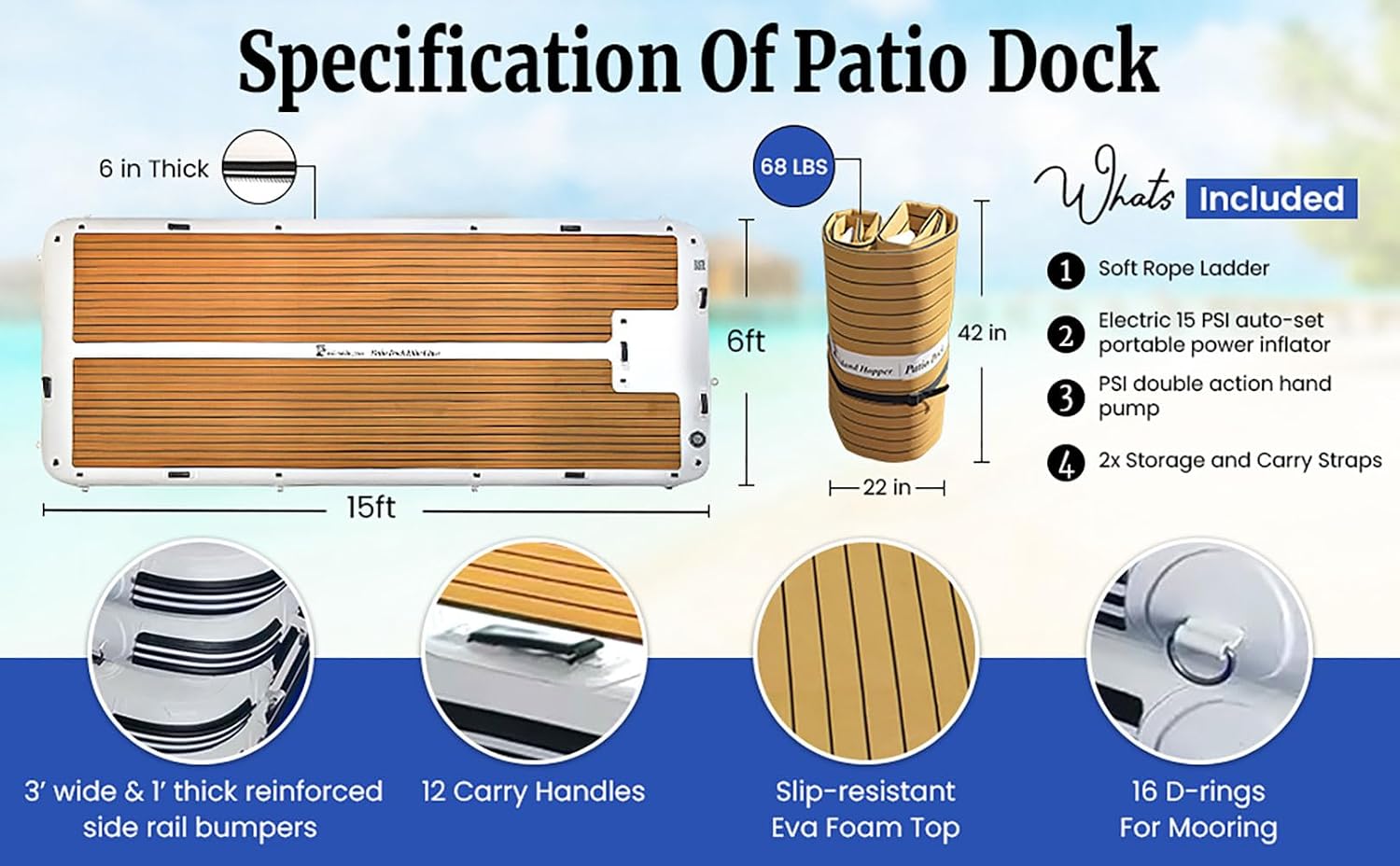
If you’ve ever seen a bright-colored floating platform anchored off a dock or beach — something people can sunbathe on, jump from, or tie a paddleboard to — that’s an inflatable floating dock. Think of it as an oversized, rigid-feeling air mattress engineered to hold real weight on real water. Unlike a permanent wood or aluminum dock bolted to pilings, an inflatable version stores in a bag over winter, inflates in under 30 minutes, and typically costs $300–$1,800 for a recreational unit — a fraction of a fixed dock installation. That sounds simple. The catch is that “inflatable” covers a wide range of construction quality, and two products that look almost identical at the product-photo stage can perform completely differently after two seasons in the sun. This guide breaks down the two core construction types, explains how to pressure-test a capacity claim before you buy, and synthesizes what long-run owners are consistently reporting so you can make a confident call at whatever budget you’re working with.
| EDITOR'S PICK[Island Hopper Mega Yacht Floati…](https://www.amazon.com/dp/B098SHMQ38?tag=greenflower20-20) | Mid-tierRetrospec Siesta Dock 7' & 10'… | Budget pick[FBSPORT Inflatable Floating Dock](https://www.amazon.com/dp/B0CRYKZML2?tag=greenflower20-20) | |
|---|---|---|---|
| Capacity | 2000 lbs | 1500 lbs | — |
| Material | PVC | — | — |
| Non-slip surface | ✓ | — | ✓ |
| Dimensions | 10' × 10' | 10' × 10' | 10ft |
| D-rings included | — | ✓ | — |
| Pump included | — | ✓ | — |
| Price | $999.00 | $749.99 | $284.99 |
| See on Amazon → | See on Amazon → | See on Amazon → |
Drop-Stitch vs. Welded-PVC: The Construction Decision That Drives Everything Else
This is the single most important spec line to find before you evaluate anything else.
Welded-PVC Construction
Welded PVC is the older, more common construction. Two sheets of coated PVC fabric are heat-welded or glued along the perimeter and internally at intervals to form an air chamber. When inflated, the platform has a rounded, slightly convex top surface — like a lilo. It’s buoyant and light, but the rigidity is limited. Under load, welded-PVC platforms flex noticeably. That flex translates directly into a bouncier, less stable surface, and it concentrates stress at the welds. According to Practical Sailor’s inflatable dock and swim platform roundup, weld-seam failure is the leading cause of early delamination in entry-level units, particularly in platforms left out in high-UV environments. Operating pressure for welded-PVC platforms typically runs 2–4 PSI — low enough that a standard hand pump can handle the job, but also low enough that overnight temperature drops meaningfully reduce effective pressure.
Who this is right for: Calm-water occasional use, kids jumping off a pontoon, a weekend swim platform with light adult traffic, budgets under $600.
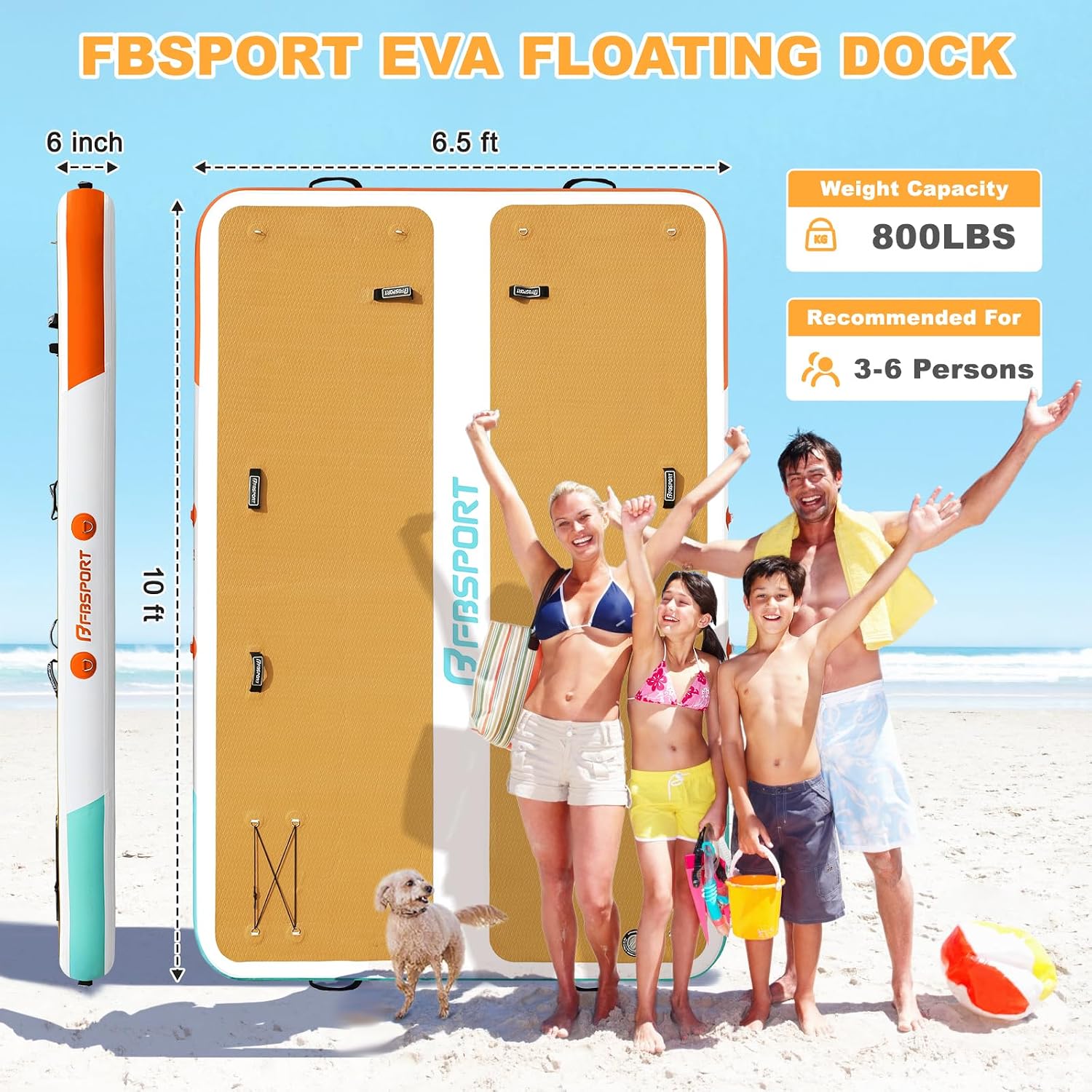
FBSPORT
$284.99
In stock on Amazon
Check price on AmazonDrop-Stitch Construction
Drop-stitch construction is borrowed from high-end inflatable SUP and inflatable kayak manufacturing. Thousands of vertical polyester threads are woven between the top and bottom fabric faces before the unit is coated and sealed. When inflated to operating pressure — typically 10–15 PSI for dock applications — those threads hold the faces parallel, producing a nearly rigid, flat surface. The platform behaves more like a foam dock pad than a balloon. Boating Magazine’s floating dock and swim platform overview notes that drop-stitch units at proper inflation feel firm enough underfoot that many owners report forgetting they’re standing on an inflatable surface. The higher operating pressure also means capacity ratings are meaningfully higher for a given footprint: a 10×10 ft drop-stitch platform commonly rates 1,000–1,500 lbs static, versus 600–900 lbs for a comparable welded-PVC unit.
The primary tradeoff is cost and pump requirements. Drop-stitch platforms run $700–$1,800 for recreational sizes, and reaching 10–15 PSI requires a quality high-pressure pump — the hand pump included in most kits tops out well below rated operating pressure.
Who this is right for: Regular adult traffic, paddleboard launching, dock-side amenity use, anyone who needs a stable platform rather than a bouncy one.
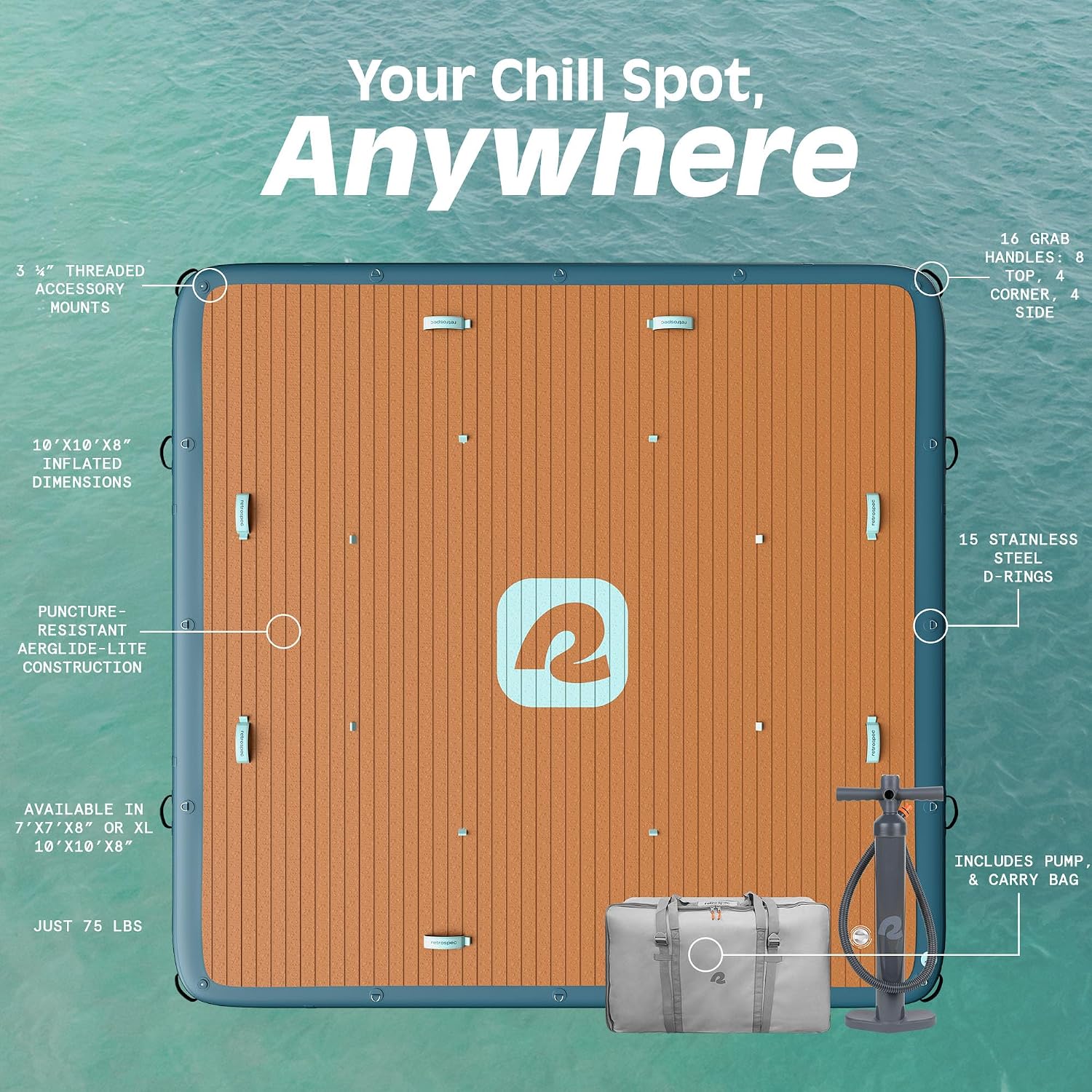
Retrospec
$749.99
In stock on Amazon
Check price on AmazonCommercial-Grade Drop-Stitch
At the top of the market, commercial-grade drop-stitch platforms use heavier-denier fabric (1,000+ denier versus 840 denier in recreational grades), reinforced valve hardware, and bonded rather than adhered non-slip surfaces. Brands occupying this tier — Aquaglide’s Swimstep XL line is the most frequently cited example in owner communities — are built for multi-season shared use in HOA, resort, and marina environments. Power & Motoryacht’s dock accessories and platform guide identifies reinforced valve hardware and integrated (rather than applied) non-slip surfaces as the two construction details that most reliably separate commercial-grade units from upper-mid recreational units at similar price points.
These platforms cost $1,400–$2,500+ and are not sized for a single family’s weekend use. They are specced for environments where daily user counts are high, liability exposure is real, and replacement logistics are costly enough that longevity genuinely matters.
Who this is right for: Marina operators, HOA waterfront amenities, resort properties, marine contractors specifying on behalf of a client with shared-use requirements.
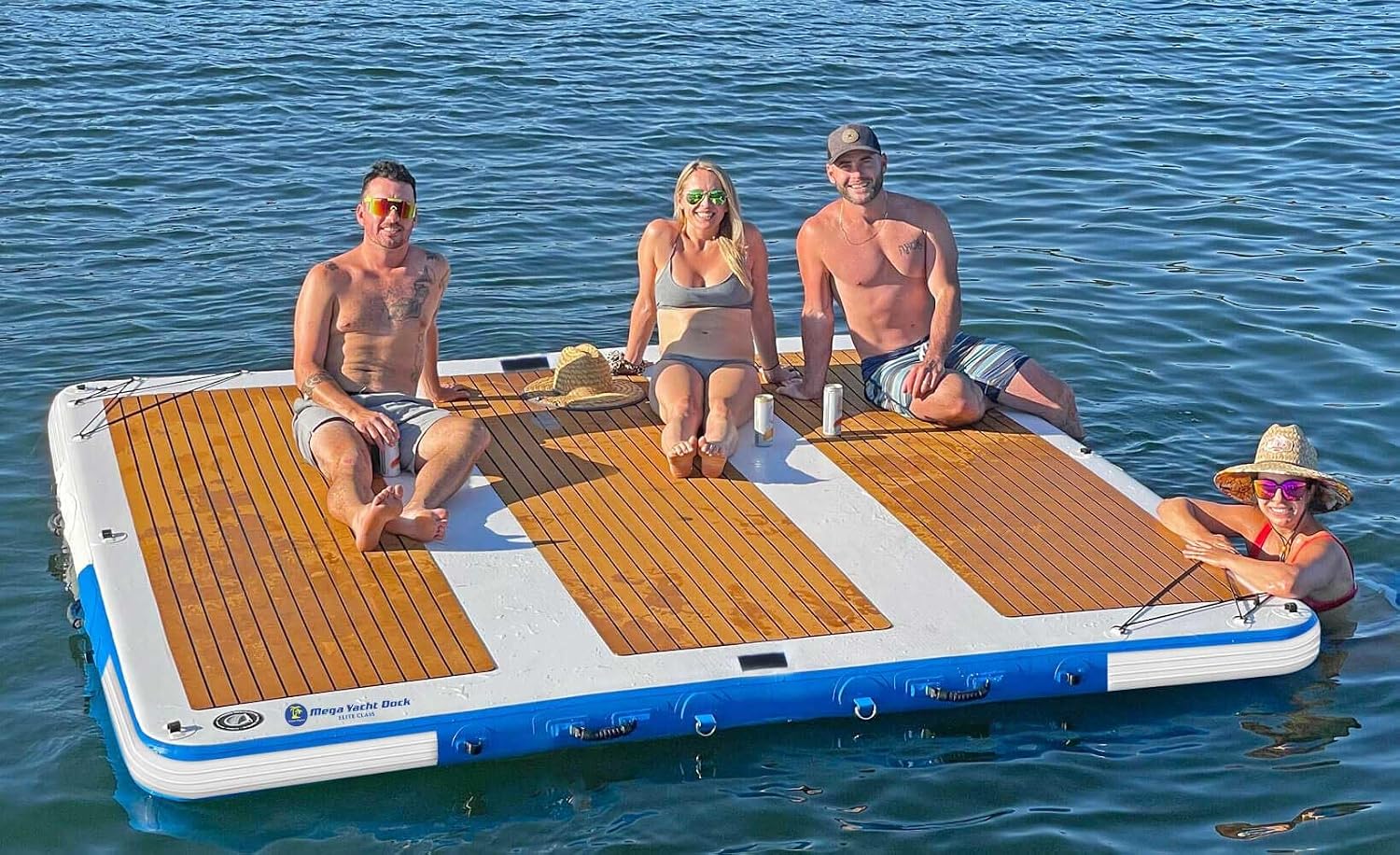
Island
$999.00
In stock on Amazon
Check price on AmazonCapacity Claims: How to Read Them Without Getting Burned
Manufacturer capacity ratings on inflatable docks are not standardized. There is no third-party certification body for recreational inflatable floating platforms equivalent to, say, ABYC for boat electrical systems. That means a “1,200 lb capacity” claim on one brand’s product page and a “1,200 lb capacity” claim on a competitor’s page may be calculated under completely different assumptions.
Three questions to ask before accepting a capacity number:
1. Is it static or dynamic? Static capacity is measured with weight distributed evenly and no movement. Dynamic load — people jumping, boats nudging the platform, wave action — multiplies stress significantly. Power & Motoryacht’s dock accessories and platform guide recommends applying a 40–50% real-world discount to published static capacity figures for any inflatable platform that will see jumping or wave wash. A 1,200 lb static rating is comfortably usable at 700–800 lbs of real-world dynamic load.
2. What PSI is the rating based on? Capacity ratings are only valid at the manufacturer’s specified inflation pressure. Owners consistently report that inflatable docks — especially welded-PVC types — lose several PSI overnight in cool water and are routinely used at half their rated pressure. A platform tested at 14 PSI and used at 8 PSI is a different product. Drop-stitch owners in long-run reviews note that investing in a quality high-pressure pump with a pressure gauge — not the hand pump included in most kits — is non-negotiable for maintaining rated performance.
3. What’s the weight distribution assumption? Some brands rate for one person standing in the center. Others rate for distributed weight across the full surface. Ask specifically, or find the capacity spec in the installation instructions rather than the marketing page — those documents tend to be more conservative and more accurate.
By the numbers — typical real-world usable capacity after applying a dynamic discount:
| Platform Type | Size | Typical Real-World Usable Capacity |
|---|---|---|
| Welded PVC | 8×8 ft | 400–550 lbs |
| Drop-stitch recreational | 8×8 ft | 700–900 lbs |
| Drop-stitch recreational | 10×10 ft | 1,100–1,400 lbs |
Overnight PSI loss in 65°F water runs 1–3 PSI across both construction types — a meaningful figure for welded-PVC platforms operating at only 3–4 PSI to begin with.
What Owners Actually Report After One to Three Seasons
Synthesizing long-run owner feedback across boating community forums and aggregated retail review data surfaces a consistent pattern that doesn’t always match the spec sheet.
The UV problem is real and almost always underweighted. Owners across both construction categories report that UV degradation — not punctures, not weld failure — is the single most common reason an inflatable dock gets retired early. This Old House’s dock materials and floating platform overview notes that PVC coatings, even 1,000+ denier grades, lose plasticizer content under sustained UV exposure, leading to surface chalking, cracking, and eventual air loss. Owners who store their platforms out of direct sun when not in use consistently report 4–6 season lifespans; owners who leave them out continuously report 1–3 seasons regardless of initial quality tier. UV-protective covers and a quality UV protectant spray applied several times per season appear repeatedly in positive long-run owner reports as the practices that most reliably extend lifespan.
Valve quality separates the tiers. In entry-level welded-PVC platforms, the Boston valve or Halkey-Roberts valve — the small screw-in fittings used to inflate and deflate — is frequently the first component to fail. Owners of budget units report valve-seat cracking within one to two seasons in high-UV environments. Drop-stitch platforms from established brands use heavier-gauge valve hardware and, owners report, are meaningfully more reliable over time. A failed valve on a welded-PVC unit often costs more to repair than the platform cost to buy, effectively ending its useful life.
Anchoring is almost always underpowered out of the box. The anchor kits included with most inflatable floating docks — a single small mushroom anchor or folding grapnel — are sized for calm, sheltered water. Owners in exposed lake positions or tidal environments consistently report drifting incidents within the first month of use. The practical fix is straightforward: oversize the anchor by a factor of two, use a chain leader to keep the rode from chafing on the platform’s edge, and add a second anchor point for anything larger than an 8×8 ft platform. Boating Magazine’s floating dock and swim platform overview recommends a minimum 15 lb mushroom anchor for platforms up to 10×8 ft in calm freshwater; saltwater or exposed positions need 20–25 lbs minimum.
Non-slip surface degrades faster than the air chamber. Several owner cohorts report that the EVA foam pad or non-slip texture applied to the top surface of drop-stitch platforms shows visible wear — peeling edges, delamination at corners — before the air chamber shows any compromise. This matters for purchasing because platforms with the non-slip coating bonded into the fabric construction (rather than applied as a separate adhered layer) hold up significantly better. When evaluating platforms, look for “integrated EVA” or “woven non-slip” language in the spec sheet rather than “foam pad included.”
The Decision Framework: If X, Then Y
If your primary use is a seasonal swim platform for a freshwater lake house with moderate traffic (2–6 people at a time, no PWC interaction): Go drop-stitch, 8×10 ft minimum, from a brand that publishes its operating PSI and uses Halkey-Roberts valves. Budget $700–$1,100. This is the sweet spot where construction quality materially improves longevity without the premium associated with commercial-grade units.
Retrospec
$749.99
In stock on Amazon
Check price on AmazonIf you’re specifying for a dock-side amenity at an HOA or resort community — multiple daily users, potential liability exposure: Don’t treat inflatable as a permanent fixture. Welded-PVC degrades too unpredictably for high-traffic shared infrastructure. If budget allows, a foam-core floating dock section from an established dock manufacturer is the right long-term answer. If inflatable is the only option, go commercial-grade drop-stitch, operate it at rated PSI daily, and plan for replacement every 3–4 seasons.
Island
$999.00
In stock on Amazon
Check price on AmazonIf you’re a marine contractor being asked to spec an inflatable platform as part of a full dock build: Your liability framing is different from the homeowner’s. Recommend drop-stitch only, document the rated capacity and your real-world dynamic discount to the client in writing, and specify a professional-grade high-pressure pump as a non-optional line item. The pump upgrade prevents the majority of capacity and longevity complaints that come back to you.
Island
$999.00
In stock on Amazon
Check price on AmazonIf you’re working with a sub-$500 budget and this is genuinely a seasonal recreational item: Welded PVC is appropriate — but be honest with yourself about what you’re buying. Store it off UV when not in use, plan to replace it in 2–3 seasons, and don’t load it to the published capacity. Treat the number on the box as a ceiling, not a target.
FBSPORT
$284.99
In stock on Amazon
Check price on AmazonOne final note on timing: Inflatable dock platforms follow the same seasonal pricing cycle as hard dock hardware. Practical Sailor’s inflatable dock and swim platform roundup notes that retailers typically move inflatable swim platform inventory at meaningful discounts in August and September as the summer season winds down. If your install timeline is flexible, buying in late summer for the following May is a legitimate way to move up a construction tier without moving up in price.