
If you’ve ever shown up at your dock on a Friday evening and spent the first twenty minutes tripping over life jackets, tangled tow ropes, and a bag of dock lines that somehow migrated under the swim ladder — this article is for you. A dock storage box (also called a deck box) is exactly what it sounds like: a weatherproof, lockable container that lives on your dock and keeps your gear dry, organized, and out of the way. They come in wildly different sizes, from compact 100-gallon units you can tuck beside a cleat post to massive 320-gallon bins big enough to swallow a winter’s worth of cushions. The goal of this piece is simple: help you pick the right size for your actual dock life, not just the biggest box that’ll fit. We’ll walk through the real tradeoffs at each size tier — including assembly quirks and product-specific gotchas that reviewers keep flagging — so you can make the call with confidence.
| EDITOR'S PICKTaylor Made Stow N’ Go Fibergla… | Mid-tier[LIFETIME 60012 Extra Large Deck…](https://www.amazon.com/dp/B0030GG2GC?tag=greenflower20-20) | Budget pick[Devoko 100 Gallon Waterproof La…](https://www.amazon.com/dp/B09N3JFSR4?tag=greenflower20-20) | |
|---|---|---|---|
| Material | Fiberglass | — | Resin |
| Capacity | — | 130 gal | 100 gal |
| Lockable | — | — | ✓ |
| Waterproof | — | — | ✓ |
| Dimensions | 24x72x23 in | — | — |
| Price | $1,040.36 | $149.97 | $76.99 |
| See on Amazon → | See on Amazon → | See on Amazon → |
Why Size Is the Wrong Starting Point (And What to Ask First)
Most buyers open a search, sort by gallon capacity, and pick the biggest box their budget allows. That logic backfires more often than you’d think, for two reasons.
First, dock real estate is finite. A 320-gallon box running 83 or more inches long eats a meaningful chunk of a standard floating dock section. If you’re on a shared dock, an HOA-managed slip, or a dock that doubles as a swim platform, that footprint matters. Second, the contents drive the decision more than abstract capacity. A family running a pontoon boat with four full-length lounge chair cushions has a completely different storage problem than a weekend kayaker who just needs somewhere to stow a throw rope, a dry bag, and a can of marine lubricant.
Ask yourself these three questions before you look at a single product:
- What’s the longest single item I need to store? (Cushions, paddle shafts, and boat hooks are the usual space-eaters.)
- Do I need to access this box solo, one-handed, in a hurry — or is a two-person lid acceptable?
- Is this box living on a covered boathouse or fully exposed to sun, rain, and salt spray year-round?
Your answers will filter the field faster than any gallon count.
Size-by-Size Breakdown: Three Tiers for Three Different Dock Lives
The 100-Gallon Tier: Compact, Accessible, and Better Than It Looks
A 100-gallon deck box — roughly 48 inches wide by 24 inches deep and 22 inches tall — is the workhorse for short-season or single-trip storage. Think: one set of dock fenders, a first-aid kit, a few personal flotation devices (PFDs — the Coast Guard–approved life jackets most docks are required to have on hand), and your rope bag. It’s not going to swallow a season’s worth of cushions, but it keeps the essential stuff within arm’s reach without dominating the dock.
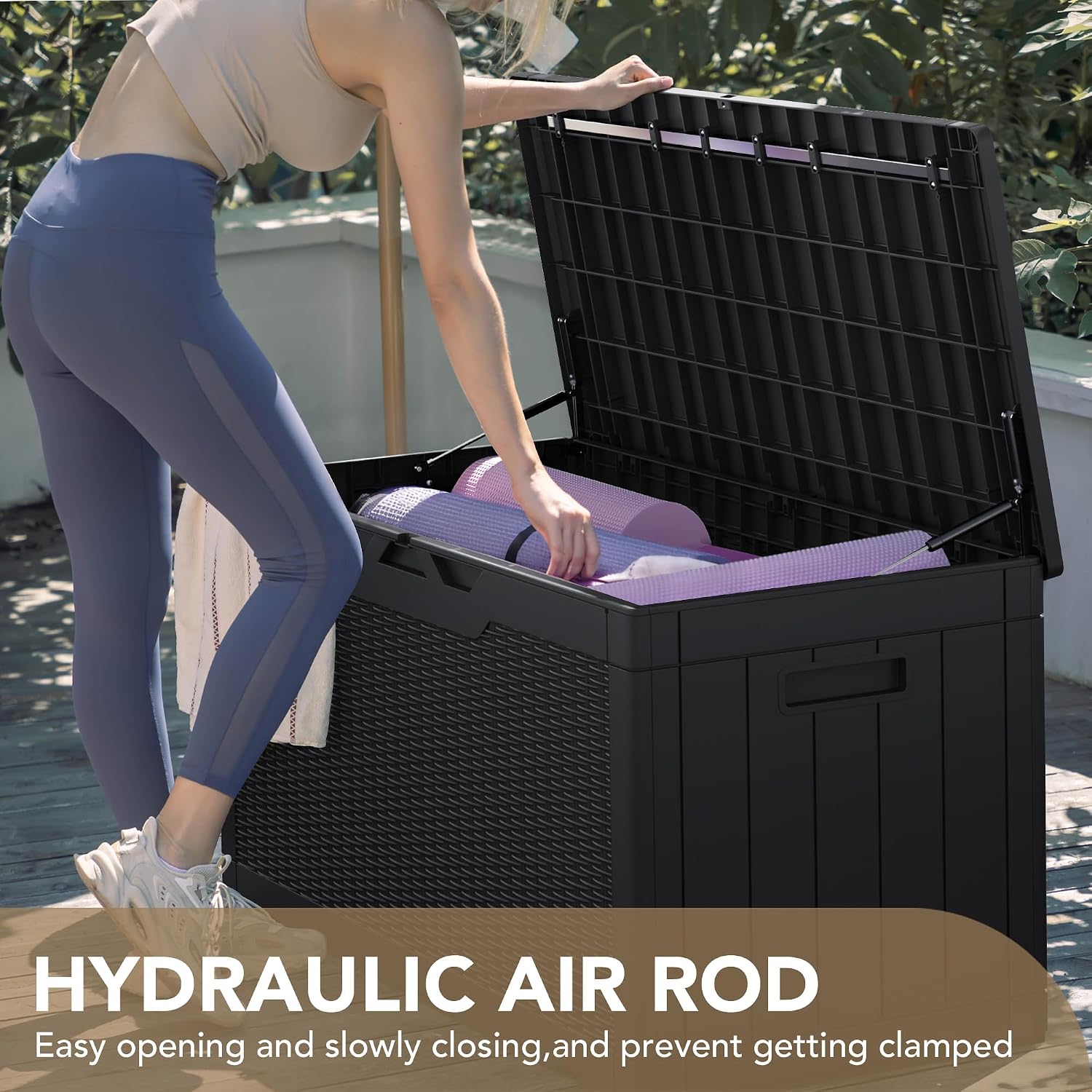
The Devoko 100-gallon box shows up repeatedly in owner reviews as a solid entry-level pick, particularly praised for its weight rating — owners consistently report that kids sitting on the lid isn’t a problem, which matters on a dock that doubles as a social space. The recurring complaint, though, is worth addressing head-on: a number of buyers report the bottom panel falling out during or after assembly.
Is the Devoko bottom panel issue a defect or an assembly error? Based on aggregated reviewer feedback and assembly documentation, this is almost always an orientation problem, not a manufacturing defect. The bottom panel has a specific snap sequence — it needs to be seated in the track before the side walls are closed and locked into position. Reviewers who flag this as a defect overwhelmingly did so before completing that snap step. The fix: lay the bottom panel in before locking a single side wall. Once you know to look for it, it’s a non-issue. That said, if you’re assembling solo in low light at the end of a dock trip, it’s the kind of step that bites people.
Practical Sailor’s dock storage and organization coverage notes that resin boxes at this size tier are generally adequate for freshwater dock environments but benefit from a UV-inhibiting finish — check that the product you’re ordering explicitly calls out UV stabilization in the resin, not just in the lid.
Devoko
$76.99
In stock on Amazon
Check price on AmazonThe 130-Gallon Tier: The Sweet Spot for Most Dock Setups
If you had to pick one size for the widest range of dock owners, 130 gallons is it. At roughly 62 inches wide, 27 inches deep, and 26 inches tall, you’ve got enough interior length to fit full-size lounge chair cushions (most run 72–76 inches, but they sit diagonally inside a 62-inch box), and the footprint is still manageable on a standard dock section.
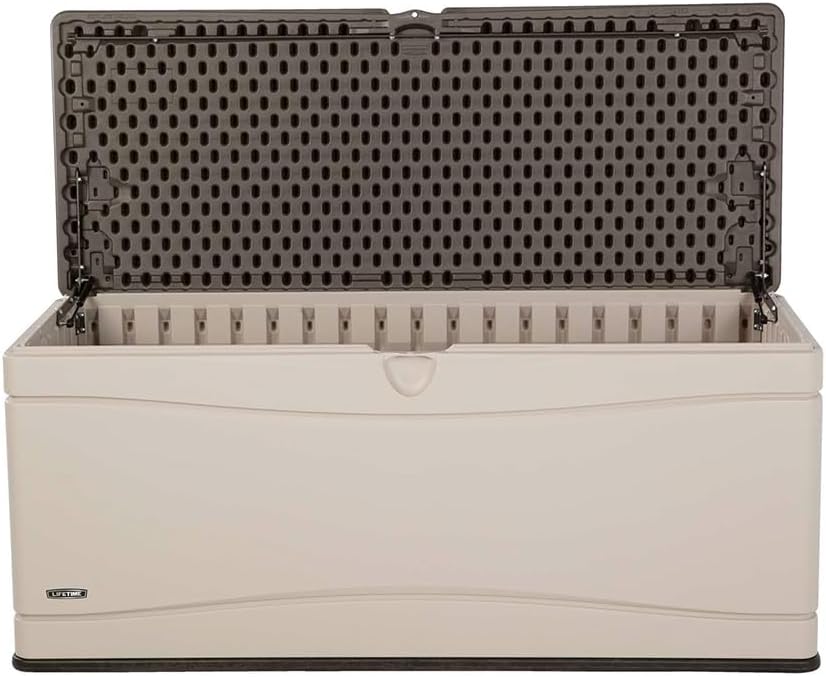
Lifetime’s 130-gallon boxes are the names reviewers keep coming back to in this size class. The brand’s double-wall, high-density polyethylene (HDPE) construction — essentially a thicker, more UV-resistant plastic — earns consistent praise for holding up season over season in direct sun without warping or fading at the same rate as single-wall competitors. This Old House’s editorial review roundup on best deck boxes specifically calls out Lifetime’s structural integrity at this size tier as above average for the price bracket.
The one assembly complaint that surfaces consistently across both Lifetime 130-gallon configurations: the metal hinge screws. Unlike the plastic clip systems used elsewhere on the box, the hinge plate requires driving metal screws into a pre-molded plastic receiver — and a number of reviewers report stripped heads or misaligned pilot holes. The fix is low-tech: use a hand screwdriver, not a drill, and seat each screw at an angle before driving it straight. Rushing this step with a power driver is where most stripped screws happen. This isn’t a reason to avoid the box — it’s a reason to read the hinge section of the instruction sheet before you pick up a tool.
By the numbers — 130-gallon interior fit check:
| Item | Typical Dimension | Fits in 130-gal? |
|---|---|---|
| Full lounge cushion (pair) | 72–76” L × 24” W | Yes, diagonally |
| Standard PFD, adult | 18” × 12” | 6–8 fit stacked |
| 50’ dock line, coiled | 14” diameter | 4–5 fit stacked |
| Kayak paddle (broken down) | 44” L | Yes, flat |
Wirecutter’s product guide on the best outdoor storage boxes notes that four full-length lounge cushions typically require a minimum of 120 gallons of interior volume with at least 60 inches of interior length — the 130-gallon class clears that bar, while the 100-gallon class does not.
LIFETIME
$149.97
In stock on Amazon
Check price on AmazonThe 320-Gallon Tier: Full-Season Storage, But Read the Fine Print
A 320-gallon deck box — often running 83–90 inches long and 30 or more inches deep — is a different category of product entirely. This isn’t a box you’re reaching into for a quick rope grab. This is where you stage an entire season’s worth of gear: cushions for a full seating group, life jackets for a family, a wakesurf rope, towels, a bag of dock hardware, and still have room left. Owners of the Devoko 320-gallon unit specifically call out the hydraulic lid rods as the feature that earns their loyalty — the lid stays open hands-free, which sounds minor until you’re alone on the dock trying to dig for something at the bottom.
Two things to plan for at this size:
You need a second person for assembly. This isn’t a hedge — reviewers are consistent and specific about it. The panel sections are large and awkward, and holding a wall panel in place while simultaneously seating the snap joint requires a second set of hands. Buyers who ignored this caveat report frustrating assemblies; buyers who grabbed a neighbor report the process going smoothly in under an hour.
The footprint math matters. At 83 or more inches long, a 320-gallon box occupies roughly seven linear feet of dock edge. On a 20-foot floating dock section, that’s over a third of your usable perimeter. Measure before you order.
Coastal Living’s seasonal dock organization guide specifically recommends this size class for lake homes where the dock serves as a primary outdoor living extension and where the alternative would be a standalone storage shed — a considerably more expensive and permitting-complicated solution.
Taylor
$1,040.36
In stock on Amazon
Check price on AmazonThe Fiberglass Option: Taylor Made and the Padlock Problem
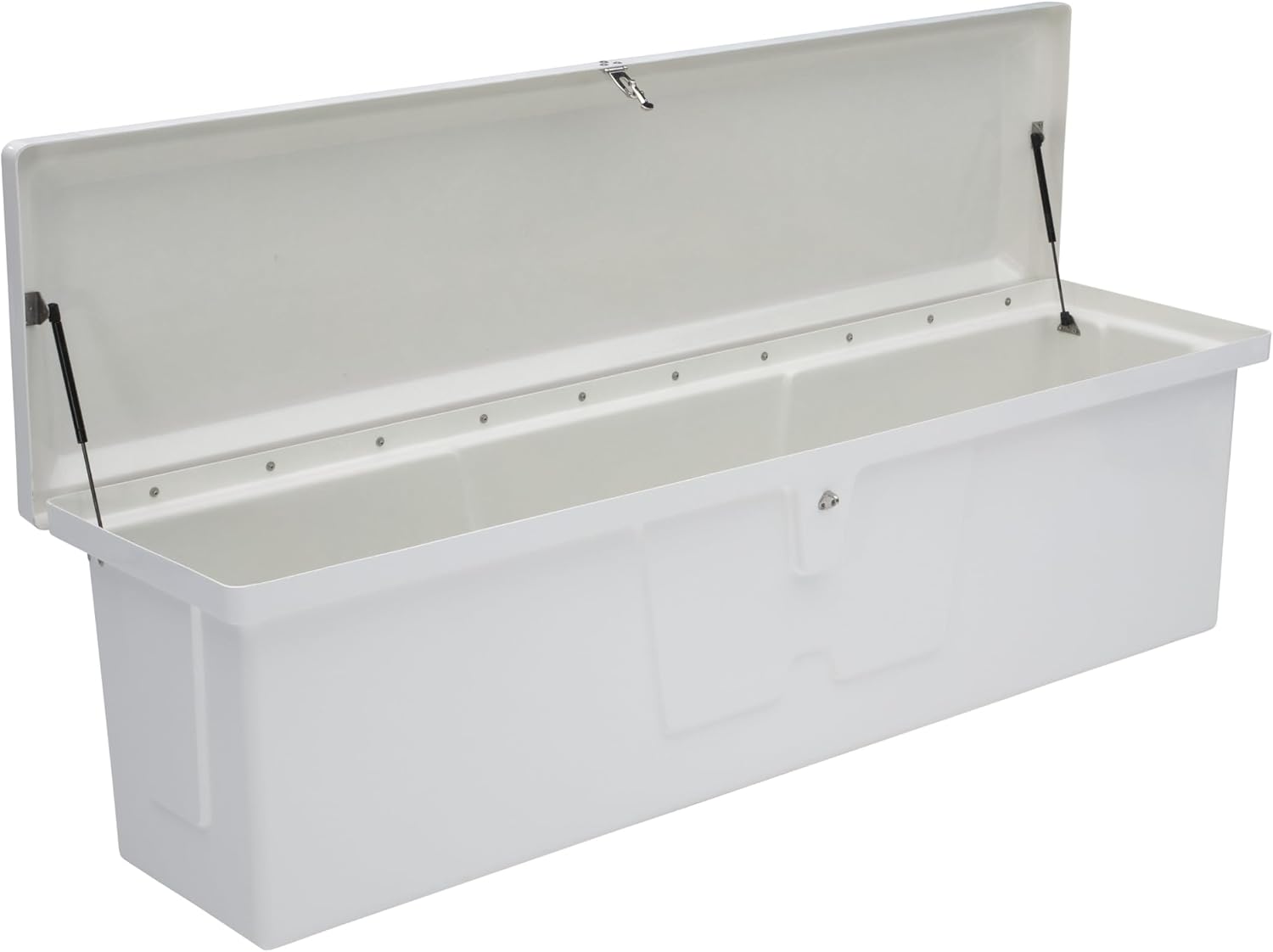
The Taylor Made fiberglass dock box sits in a different category from the resin boxes above — it’s heavier, more marine-specific in its construction, and priced accordingly. Fiberglass (a composite material made from glass fibers set in a resin matrix) is genuinely more UV- and impact-resistant than standard HDPE resin for saltwater environments, and owners consistently cite its longevity as the justification for the price premium.
But there’s one product-specific gotcha that surfaces in reviews with enough regularity that it needs to be called out directly: the lock hole accepts only a 1/4-inch shackle diameter. Standard padlocks use a 5/16-inch or 3/8-inch shackle. If you grab a generic padlock at a hardware store and show up at the dock expecting to lock this box, it won’t fit. You need a slimline padlock or a dedicated hasp-style lock with a 1/4-inch shackle. Reviewers who missed this detail feel genuinely misled, because the box has a lock hole and ships without explanation of the constraint. Now you know — plan accordingly before the box arrives.
Practical Sailor’s dock storage and organization coverage notes that fiberglass construction offers meaningfully better long-term resilience than HDPE resin in harsh saltwater environments with regular wave or spray exposure — a relevant consideration if your dock is on a tidal estuary or an exposed coastal slip rather than a protected freshwater lake.
Will a Resin Deck Box Stay Watertight on a Fully Exposed Dock?
The honest answer: mostly, for most conditions, but not in the same way a marine-grade sealed container would be. Resin deck boxes rely on a lid overlap and friction fit, not a gasket seal. In a direct downpour or a wave splash event, some water intrusion is possible at the lid seam. The practical countermeasure: store any gear that’s genuinely moisture-sensitive (electronics, first-aid kits, chemical treatments) inside a dry bag inside the deck box. The box handles the bulk of weather; the dry bag handles the critical items.
On a covered boat lift or under a dock roof, even entry-level resin options perform well across multiple seasons. In a fully exposed saltwater environment, the Taylor Made fiberglass unit’s construction provides meaningfully better long-term resilience than HDPE resin — and the price reflects that.
Frequently Asked Questions
What size deck box do I need for four full-length lounge chair cushions? Plan for a minimum of 120 gallons of interior volume and at least 60 inches of interior length. Wirecutter’s best outdoor storage boxes guide confirms this threshold. The 130-gallon tier clears it; the 100-gallon tier does not.
Can I sit on top of a resin deck box without damaging it? For most HDPE boxes rated 250 lbs or higher, yes — owners of the Devoko 100-gallon specifically mention kids sitting on the lid without issue. Check the manufacturer’s listed weight rating before assuming any specific box supports this use.
What padlock fits the Taylor Made fiberglass dock box? You need a padlock with a 1/4-inch (6mm) shackle diameter. Standard hardware-store padlocks will not fit. A slimline padlock specifically rated for 1/4-inch hasp applications is what you’re looking for.
Is the Devoko bottom panel falling out a defect or an assembly error? Aggregated reviewer feedback strongly points to assembly orientation — specifically, failing to seat the bottom panel before closing and locking the side walls. Follow the snap sequence in the instructions and this issue does not occur.
Do I need a second person to assemble the 320-gallon box? Yes, practically speaking. Reviewers are consistent: panel sections at this size require one person to hold and one to seat and snap. Budget for a helper.
Will a resin deck box stay watertight in a fully exposed dock environment? It will handle most rain and spray well, but it is not gasket-sealed. Store moisture-critical gear in a dry bag inside the box as a secondary layer of protection. For harsh saltwater environments with regular wave exposure, fiberglass construction offers better long-term resilience.
The Decision Rule
Here’s the clean version:
- Short-season or single-trip storage, tight dock footprint: 100-gallon resin. Keep assembly instructions open to the bottom-panel step.
- Full-season storage, lounge cushions, family-size gear load, freshwater: 130-gallon HDPE. Read the hinge section before picking up a screwdriver.
- Full dock-as-living-space setup, maximum capacity, hands-free lid: 320-gallon. Recruit a second person for assembly day.
- Saltwater, long-term installation, willing to pay for durability: Taylor Made fiberglass. Order the right padlock before the box arrives.
The box that fits your dock is the one sized for what you’re actually putting in it — not the largest one that ships free.