A dock cleat is the metal fitting — typically a two-horned, T-shaped piece of hardware — that you wrap a line around to secure your boat to the dock. Every dock has them. But not all cleats are made from the same material, and in a saltwater environment that difference stops being a spec-sheet detail and starts being a maintenance bill or a safety failure. This article compares the two most common cleat materials you’ll encounter when outfitting or upgrading a dock: 316 stainless steel and hot-dip galvanized steel. We’ll define what each actually means, show you what salt air and seawater do to each over a realistic timeline, run the honest cost math, and leave you with a clear decision rule you can apply before your next hardware order ships.
If you’re on a freshwater lake in the Midwest, this comparison lands differently than if you’re building a dock slip in the Florida Keys or coastal Maine. We’ll call that out explicitly.
What “316 Stainless” and “Galvanized” Actually Mean
These terms get thrown around interchangeably at marine supply counters, but they describe completely different approaches to corrosion resistance.
316 stainless steel is an iron-based alloy containing chromium (roughly 16–18%), nickel (10–14%), and — critically — molybdenum (2–3%). That molybdenum addition is the entire reason 316 exists as a separate grade from its cheaper cousin, 304. As documented in Practical Sailor magazine’s editorial coverage of stainless steel fasteners and fittings, molybdenum dramatically improves resistance to chloride ion attack — the exact corrosion mechanism that saltwater triggers. The “316” designation comes from the AISI (American Iron and Steel Institute) numbering system. You’ll also see 304 stainless on dock hardware; it looks identical to 316 but corrodes significantly faster under salt exposure. When a marine supplier says “marine-grade stainless,” they should mean 316. Ask for the alloy grade in writing before you buy.
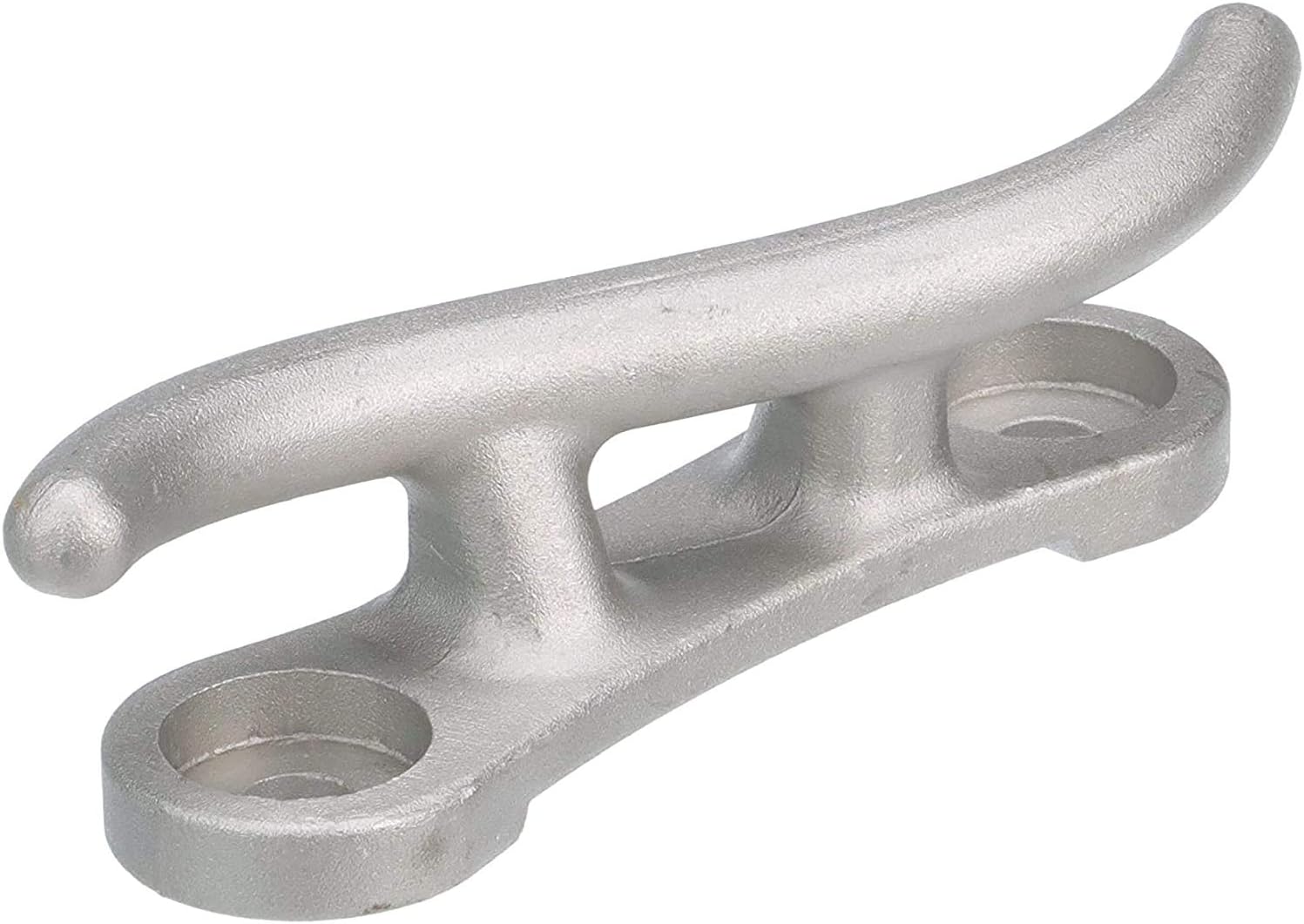
Hot-dip galvanized steel takes ordinary mild steel and submerges it in a bath of molten zinc at roughly 850°F. The zinc bonds metallurgically to the steel surface, forming a layered coating. Per ASTM International’s ASTM A153, Standard Specification for Zinc Coating (Hot-Dip) on Iron and Steel Hardware, a properly galvanized fitting carries a minimum coating thickness measured in ounces of zinc per square foot. That zinc layer acts as a sacrificial barrier: it corrodes so the steel underneath doesn’t have to — at least for a while. The American Galvanizers Association’s technical publication “Hot-Dip Galvanizing for Corrosion Protection” describes this mechanism as cathodic protection — the zinc is electrochemically more active than steel, so it takes the corrosive hit first.
These are two fundamentally different strategies: 316 stainless resists chloride corrosion at the alloy level; galvanized steel sacrifices a zinc coating to delay it.
What Saltwater Does to Each Material Over Time
This is where the comparison gets concrete. Saltwater isn’t just water with dissolved salt — it’s a corrosive electrolyte that accelerates oxidation, especially when combined with heat, UV exposure, and the physical abrasion of lines under load.
Galvanized Cleats in Saltwater
The zinc coating on a hot-dip galvanized cleat begins reacting with chloride ions almost immediately in a full saltwater environment. In coastal conditions — tidal splash zones, salt air within a half-mile of open ocean — galvanized hardware typically shows white rust (zinc oxide formation) within one to two seasons. Power & Motoryacht magazine’s editorial coverage of dock fitting materials notes that galvanized fittings in direct saltwater contact are generally considered a 3–7 year material in high-salinity environments before structural integrity becomes a concern.
Here’s the failure sequence owners consistently report: the zinc layer depletes fastest in the areas that see the most mechanical wear — the horns of the cleat where the dock line runs and chafes. Once the zinc is gone in those spots, the underlying steel is exposed to salt and oxygen simultaneously. Red rust follows quickly. A cleat that looks cosmetically acceptable from ten feet away may have compromised load capacity at the horn base where you can’t easily see it.
There’s also a galvanic corrosion risk that’s easy to overlook: if you mount a galvanized cleat with 316 stainless fasteners — or vice versa — you’ve created a dissimilar-metal couple in an electrolyte. Practical Sailor magazine’s published analysis of stainless fastener interactions in marine environments documents how this accelerates corrosion of the less noble metal — in this case, the zinc coating — faster than either material would corrode alone. Match your fastener material to your cleat material, every time.
 product image](/images/external/d3db65cfb852.jpg)
Seachoice
$13.33
In stock on Amazon
Check price on Amazon316 Stainless Cleats in Saltwater
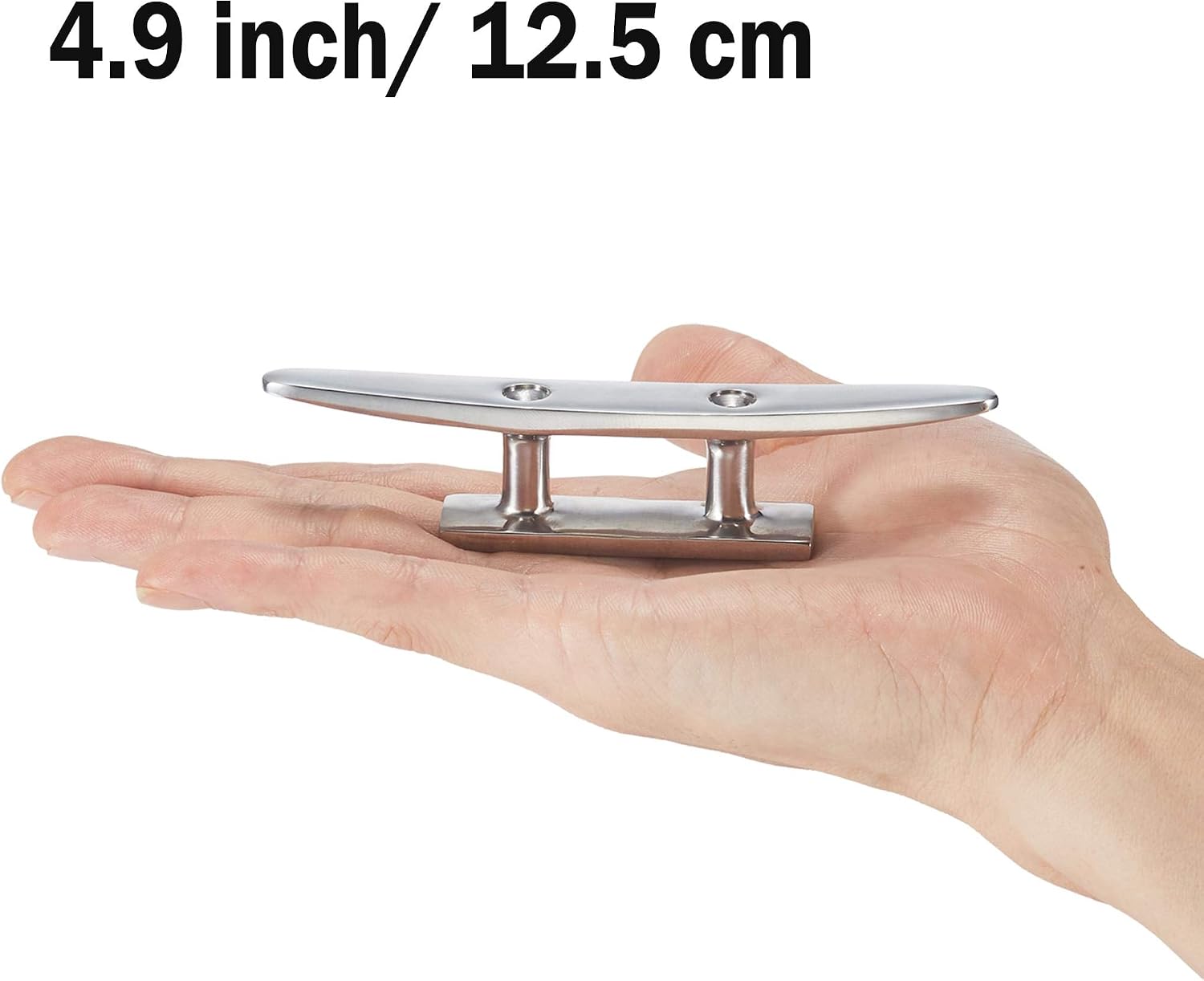
316 stainless performs categorically differently. The chromium oxide passive layer that protects stainless steel continuously self-repairs in the presence of oxygen. The molybdenum content specifically resists the pitting corrosion that chloride ions initiate. Boating Magazine’s dock hardware editorial coverage confirms that primary tie-off cleats in any saltwater environment warrant 316 stainless as the baseline professional specification — not an upgrade tier. Owners in high-salinity coastal environments consistently report 15–25+ year service life with no structural degradation when 316 stainless cleats are mounted with matched 316 stainless fasteners and are not buried under standing water in a sealed crevice.
That last point matters: crevice corrosion under mounting plates is 316’s one real vulnerability in stagnant chloride environments. Where a cleat base sits flush against a perpetually wet dock surface without drainage, the stagnant chloride-rich water trapped under the base can concentrate and attack even 316 stainless over time. The fix is straightforward — use backing plates with drainage allowance or a thin neoprene gasket that allows airflow — but it’s worth knowing before you bolt your cleats down. Accon Marine’s published product specification sheets for their 316 stainless cleat lines explicitly document the alloy composition and call out proper mounting clearance as a condition of expected performance, a level of transparency that budget hardware suppliers rarely match.
MarineNow
$153.00
In stock on Amazon
Check price on AmazonGalvanized Cleats in Freshwater
If your dock is on a freshwater lake, river, or reservoir, galvanized cleats perform meaningfully better than their saltwater numbers suggest. Without chloride ions as the primary attack mechanism, the zinc coating degrades much more slowly. The American Galvanizers Association’s published corrosion rate data for zinc in low-chloride freshwater environments supports owner reports of 10–15 years of acceptable performance from quality galvanized cleats with minimal maintenance.
That said, a few freshwater caveats apply. Acidic water — common in mountain lakes and some New England watersheds with high tannin content — accelerates zinc depletion faster than neutral freshwater. If your lake runs below pH 6.5, galvanized longevity estimates shrink considerably. Ice damage in freeze/thaw climates also causes mechanical damage to zinc coatings that exposes the base steel, compounding the failure timeline for owners on seasonal docks.
For pure freshwater applications with neutral pH and no extreme freeze cycling, quality hot-dip galvanized cleats represent a legitimate value choice — particularly for secondary cleats (fender tie-offs, utility lines) where primary safety loads aren’t at stake.
ZOMCHAIN
$18.79
In stock on Amazon
Check price on AmazonThe Cost Math: Is 316 Actually Worth the Premium?
Let’s run the numbers honestly. The following comparison uses typical 2026 retail pricing for a 6-inch cleat in each material category. Each row represents one of the three realistic buyer scenarios you’ll encounter when specifying dock hardware.
| Specification | Hot-Dip Galvanized (6” cleat) | 316 Stainless (6” cleat) |
|---|---|---|
| Typical retail price | $8–$18 | $35–$90 |
| Expected saltwater lifespan | 3–7 years | 15–25+ years |
| Annualized cost (midpoint) | ~$3.30–$5.20/yr | ~$2.20–$5.60/yr |
| Replacement labor (per cycle) | Full remount required | Rarely needed |
| Recommended use case | Freshwater secondary cleats | Saltwater primary tie-offs |
Scenario One: DIY Saltwater Dock Owner
Seachoice
$13.33
In stock on Amazon
Check price on AmazonAt midpoint estimates, the annualized cost per cleat is actually comparable between galvanized and 316 stainless — and that’s before factoring in labor. If you’re a DIY installer replacing four cleats every five years, each cycle costs you an afternoon and consumables. But the physical reality of removing corroded hardware from a salt-saturated dock surface is its own tax: seized fasteners, stained decking, and the recurring interruption of your boating season. For the DIY saltwater owner, galvanized cleats are not actually cheaper once you account for the true cost of repeated replacement work. The annualized math nearly equalizes, and the aggravation doesn’t show up in any spreadsheet.
For a saltwater DIY application, stepping up to 316 stainless the first time eliminates that recurring aggravation entirely. Install correctly with matched 316 fasteners and adequate drainage under the base plate, and the hardware becomes a non-issue for the foreseeable future.
Scenario Two: Marine Contractor or Property Manager
MarineNow
$153.00
In stock on Amazon
Check price on AmazonIf you’re a property owner who hires a marine contractor, each replacement visit in the current labor market runs $150–$350 in labor alone, based on typical coastal contractor rate structures documented in Power & Motoryacht magazine’s editorial coverage of dock maintenance economics. That labor math collapses the galvanized cost advantage almost immediately. After a single replacement cycle on a four-cleat dock, the cumulative cost of galvanized hardware — parts plus labor, twice — exceeds the one-time cost of 316 stainless installed correctly the first time.
For anyone managing shared infrastructure — a homeowners association slip, a marina berth, or a rental property dock — the liability calculation runs parallel to the cost calculation. Boating Magazine’s dock hardware editorial guidance is explicit on this point: primary tie-off cleats in saltwater environments have no professionally defensible specification below 316 stainless. Hardware failure under storm load or surge is an exposure that no maintenance budget savings justifies. Specify 316, document it in the property maintenance records, and close the file.
Scenario Three: Freshwater or Budget-Constrained Secondary Hardware
ZOMCHAIN
$18.79
In stock on Amazon
Check price on AmazonThe one scenario where galvanized hardware earns a genuine recommendation is freshwater secondary hardware on a constrained budget. Fender cleats, utility tie-offs, and secondary positioning cleats on a freshwater lake dock — where primary bow and stern loads are already handled by 316 stainless or equivalent hardware — are a reasonable application for ASTM A153-compliant hot-dip galvanized fittings. The key qualifier is always ASTM A153 compliance: this standard governs the hot-dip process and minimum coating thickness. Electroplated zinc, sometimes sold as “zinc-plated” or “electrogalvanized,” does not meet this standard and should not be used in any outdoor dock application. Coating thickness on electroplated hardware is measured in microns where hot-dip galvanized is measured in thousandths of an inch — the performance difference in field exposure is proportional.
Specifications Worth Confirming Before You Buy
Not all stainless and not all galvanized hardware is equal. A few things worth verifying when comparing products:
For 316 stainless cleats:
- Confirm the alloy grade in writing before purchase. “Stainless steel” without a grade designation often means 304, not 316. Manufacturers like Accon Marine — per their published specification sheets — explicitly state the alloy grade. If a supplier won’t provide this in writing, treat the product as 304 until proven otherwise.
- Verify that any fastener hardware supplied or recommended is also 316 stainless. Mixing grades creates a galvanic couple that accelerates corrosion of the lower-grade component, as documented in Practical Sailor magazine’s analysis of stainless fastener interactions in marine environments.
- Look for cast or forged construction versus stamped or folded. Stamped cleats have thinner cross-sections at stress points regardless of alloy grade.
For galvanized cleats:
- Hot-dip galvanized outperforms electroplated zinc significantly in both coating thickness and field durability. ASTM A153 compliance on the product label indicates the hot-dip process was used.
- Inspect coating uniformity on the actual hardware. Drips, runs, and bare spots aren’t purely cosmetic — they indicate uneven thickness that creates early failure initiation points.
- Match fastener material to cleat material. Galvanized fasteners with a galvanized cleat; 316 fasteners with a 316 cleat.
The Clear Decision Rule
If your dock is in saltwater, under tidal influence, or within a half-mile of open ocean: Specify 316 stainless for all primary tie-off cleats. The annualized cost difference versus galvanized is negligible once you account for replacement cycles and labor, and the safety margin is not negotiable. Match your fasteners to the same grade. Mount with drainage clearance under the base plate to prevent crevice corrosion at the one point where 316 is genuinely vulnerable.
MarineNow
$153.00
In stock on Amazon
Check price on AmazonIf your dock is on fresh water with neutral pH, no extreme ice cycling, and you’re working within a tight budget: Quality hot-dip galvanized cleats confirmed to ASTM A153 are a defensible choice for secondary and utility cleats. For primary bow and stern tie-off points — especially on vessels over 24 feet or any dock used for regular passenger boarding — step up to 316 stainless even in freshwater. The load stakes justify it.
ZOMCHAIN
$18.79
In stock on Amazon
Check price on AmazonIf you’re specifying for a client or managing shared infrastructure: 316 stainless is the only professionally defensible specification for any environment with chloride exposure. Galvanized hardware in a saltwater marina is a deferred maintenance liability. Put 316 in the spec, document it, and move on.
Seachoice
$13.33
In stock on Amazon
Check price on AmazonThe price gap between galvanized and 316 stainless closes faster than most buyers expect once you account for lifespan. In saltwater, it closes almost immediately. Buy the 316 once, mount it correctly with matched fasteners and adequate drainage under the base plate, and stop thinking about your cleats for the next two decades. That’s the value proposition in plain terms.