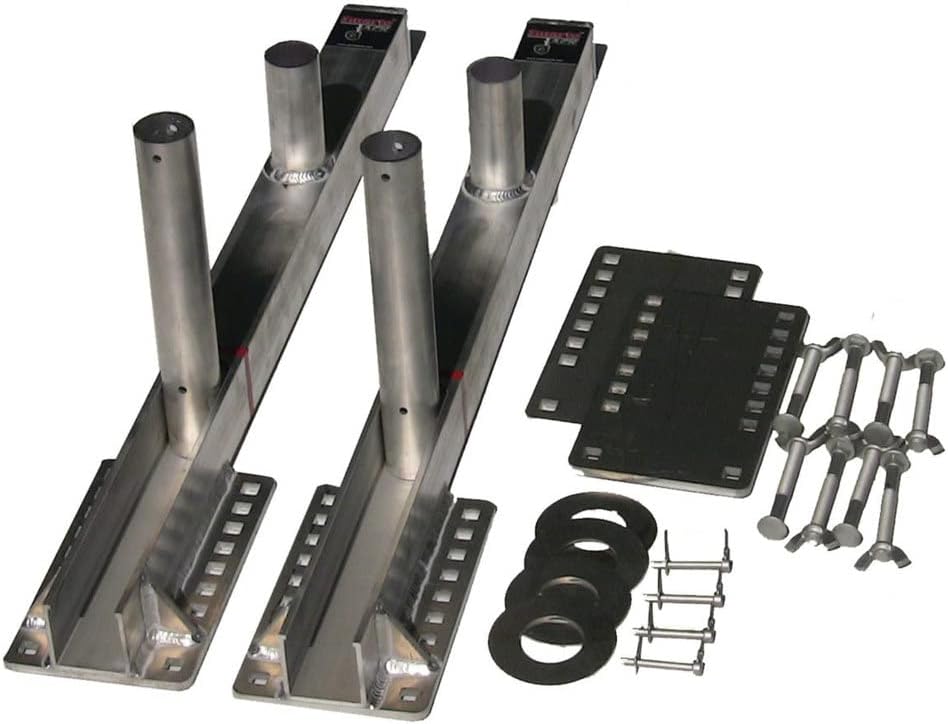
A boat lift — the mechanical cradle system that raises your boat out of the water when it’s not in use, protecting the hull from algae, waterline staining, and prolonged submersion — is one of the most practical investments a lakefront property owner can make. Most lifts stand on four vertical pipes called legs that rest directly on the lake floor. On a firm sand or gravel bottom, that works fine. But on soft silt, clay, or muck — the thick, loose sediment common in older glacial lakes, coves with low water movement, or beds with heavy organic matter — those narrow leg tips can slowly sink, causing the entire lift to tilt, bind, and eventually become unusable. Boat lift wheel kits (also called mud feet, caster feet, or wide-base leg pads) are aftermarket or factory add-on assemblies that replace narrow leg tips with wider wheels or plates to spread the load and, in some configurations, let you roll the lift in and out of position. This article walks you through which designs hold up on soft bottoms, which ones disappoint, and how to pick the right kit for your situation.
Why Soft Bottoms Break Standard Lift Legs — and What “Load Spreading” Actually Means
Here’s the physics in plain terms. A standard 2-inch-diameter lift leg tip concentrates the entire corner load — typically 400 to 700 lbs per leg on a four-post lift holding a 3,000-lb boat — onto roughly 3 square inches of contact. That’s somewhere in the range of 130–230 psi per leg tip pressing down on a substrate that has the structural integrity of wet clay. The leg sinks. Slowly at first, then faster once the lip of the pipe begins to auger into the sediment.
Wheel kits solve this by increasing the contact footprint. A 10-inch-diameter wheel foot — like the style used in the ShoreMaster Wheel Kit series, per ShoreMaster’s product documentation — distributes that same 500-lb corner load across roughly 78 square inches, dropping contact pressure to under 7 psi. That’s the difference between a stiletto heel and a snowshoe. It’s not magic; it’s geometry. The practical implication for your buying decision is that wheel diameter and width are the primary specs to optimize for soft bottoms, not brand name, finish, or price.
Where it gets nuanced: rolling ability matters separately from flotation. Some wide-base feet are essentially flat mud pads — they spread load well but don’t roll, which means repositioning the lift requires lifting or dragging it. True wheel kits have an axle-mounted wheel that allows the lift to be pushed horizontally along the lake floor. On firm-enough muck, this is enormously useful. On very deep, fluid silt, the wheel simply plows a channel and the mechanical advantage disappears. Knowing your bottom depth and consistency before you buy is the single most important pre-purchase step, and it costs you nothing but ten minutes with a wooden dowel pushed into the lakebed.
The Four Kit Types, Compared Honestly
1. Flat Mud Plates (Pad Feet)
These are the simplest and least expensive option — a welded steel or aluminum plate, typically 6 to 12 inches square, that bolts or pins to the bottom of the lift leg. Hewitt Manufacturing’s Owner’s Manual and Bottom Conditions Reference describes these as appropriate for “moderately soft bottoms with 1–3 inches of surface sediment over a firmer substrate.” The upside: low profile, nothing to snag weeds, inexpensive (often $60–$120 for a four-pad set). The downside: they don’t roll, they don’t self-level, and on very soft bottoms they sink almost as readily as bare legs because the load-per-square-inch reduction, while real, isn’t dramatic enough when the underlying layer is fluid silt rather than compacted clay.
Best for: Bottoms with a thin muck layer over firm sand or clay. Not recommended for lake beds with more than 4–6 inches of silt.
2. Single-Axle Wheel Kits (Standard Diameter, 8–10 Inch)
This is the most common aftermarket upgrade category and the one most owner communities gravitate toward for mid-range soft-bottom situations. A single polyurethane or hard rubber wheel mounts on a galvanized or stainless axle pin that runs through a u-bracket welded or clamped to the leg base. The wheel rolls the lift in and out; when stationary, the flat side of the wheel rests on the bottom and spreads load reasonably well.
Boating Magazine’s Spring 2025 dock and lift buyer’s guide calls out wheel diameter as the key variable: “eight inches is functional for firm-soft bottoms; ten-inch wheels begin to make a meaningful difference on genuine muck.” Across aggregated owner reviews on boating-specific forums and retailer Q&A threads, the pattern that emerges is that 8-inch kits from brands like Lift-All work acceptably in 1–4 inches of silt, while 10-inch kits hold up better when that silt layer is 4–8 inches deep. Material matters here too: polyurethane wheels resist UV degradation and don’t rust; avoid steel-core wheels in freshwater environments with high organic content (tannins accelerate rust faster than saltwater in some testing documented by Practical Sailor’s hardware longevity coverage).
Best for: The widest range of soft-bottom situations; the starting point for most buyers.
3. Wide-Track Dual-Wheel Kits (10–12 Inch, Side-by-Side)
These are the heavy-hitters for genuinely problematic bottoms — two wheels side by side on a wider axle, doubling the contact footprint versus a single-wheel kit. Golden Boat Lifts’ 2024 specification sheets list their dual-wheel mud foot as rated for lifts up to 6,000 lbs total capacity on “soft, unstable lake floors.” The contact footprint on a 12-inch dual-wheel assembly runs approximately 180–220 square inches, pushing contact pressure down to 2–3 psi at typical per-leg loads — meaningfully better than single-wheel kits.
The trade-offs: wider track means more drag when pushing the lift through thick muck, and weeds tangle more easily in dual axles. They’re also significantly heavier assemblies — typically 18–28 lbs per corner versus 6–12 lbs for a single-wheel kit — which is a real consideration if you’re retrofitting an older lift solo. Price runs $180–$320 per corner for quality dual-wheel assemblies, putting a full four-corner kit in the $700–$1,300 range before installation hardware.
Best for: Bottoms with 6+ inches of fluid silt; lifts in the 4,000–8,000 lb capacity range; lake coves with no firm substrate within 12 inches.
4. Swivel-Caster Kits (360° Rotation)
Niche but useful: swivel casters replace the fixed-direction wheel with a full 360-degree rotating axle assembly, allowing the lift to be repositioned in any direction without picking up a leg. Operators in long-run reviews note that swivel kits shine in tight marina slips or shared dock environments where precise lateral adjustment is needed. The vulnerability on soft bottoms is the swivel joint itself — more moving parts, more sediment infiltration, more maintenance. ShoreMaster’s installation guide specifically cautions against swivel-caster kits “in high-silt environments where sediment packing in the swivel joint can seize the caster within one season.”
Best for: Firm to moderately soft bottoms where maneuverability, not flotation, is the primary problem.
By the Numbers: Contact Pressure Across Kit Types
| Kit Type | Approx. Contact Area (per leg) | Est. Contact Pressure (500 lb/leg) |
|---|---|---|
| Bare 2” pipe leg | ~3 sq in | ~165 psi |
| Flat mud plate (8”×8”) | ~64 sq in | ~8 psi |
| Single 10” wheel | ~75–80 sq in | ~6–7 psi |
| Dual 12” wheel kit | ~190–220 sq in | ~2–3 psi |
Estimates based on published footprint specs from ShoreMaster and Golden Boat Lifts documentation; actual pressure varies with boat weight distribution and wheel-to-bottom contact angle.
Material Grade: What Actually Corrodes in Freshwater Muck
This is where a lot of buyers leave money on the table. Freshwater lake bottoms — especially organic muck — are mildly acidic and contain sulfur compounds produced by decomposing vegetation. Practical Sailor’s coverage of marine hardware longevity notes that galvanized steel in high-organic freshwater environments can show through-rust at weld seams within three to five seasons, particularly at the wheel axle collar where moisture traps. The implication for wheel kits:
- Hot-dip galvanized steel is acceptable for the structural bracket if it’s a heavy-coat (not electrogalvanized) application and you’re in a low-organic freshwater environment. Inspect the weld collars annually.
- Powder-coated aluminum brackets with stainless axle pins (304 SS is fine for freshwater; 316 is overkill unless you’re on a brackish or tidal lake) represent the best long-term value for most soft-bottom lake applications.
- Polyurethane wheels outlast rubber in UV exposure and resist silt absorption better than foam-filled options. Owners consistently report 8–12 seasons from quality poly wheels versus 4–6 from rubber in comparable conditions.
Avoid chrome-plated or nickel-plated axle hardware entirely — decorative finishes, not corrosion protection in a muck environment.
The Install Question: Retrofit vs. Factory Option
If you’re buying a new lift, getting wheel kits factory-configured is meaningfully easier than retrofitting. The bracket welds land at the correct height to maintain your lift’s level geometry; aftermarket retrofits sometimes require shimming or leg-length adjustment to compensate for the added height the wheel assembly introduces at the base. ShoreMaster’s installation documentation flags this explicitly: “Adding a wheel kit to an existing lift may raise the cradle height by 2–4 inches; adjust drive cable tension and cradle height accordingly before first use.”
For retrofit buyers, verify leg tube diameter compatibility before ordering. Common leg tube ODs run 2 inch, 2.375 inch, and 3 inch; most wheel kits either clamp or pin to the tube. If your lift uses proprietary legs with an unusual OD, contact the manufacturer directly — universal-fit kits exist but bracket slippage on non-standard tubes is the most common complaint category in aggregated owner reviews.
The Decision Rule: If X, Then Y
If your bottom has less than 3 inches of silt over firm substrate: flat mud plates or an 8-inch single-wheel kit is likely sufficient, and you don’t need to spend more than $150–$250 for a four-corner set.
If your bottom has 3–6 inches of soft silt: a 10-inch single-wheel kit in powder-coated aluminum with a stainless axle pin is the call. Budget $300–$600 for quality assemblies. This covers the majority of soft-bottom lake situations in the Midwest and Northeast as of 2026.
If your bottom has 6+ inches of fluid muck, or if your lift capacity exceeds 4,000 lbs, or if you’ve watched a previous lift tilt measurably within one or two seasons: go straight to dual 12-inch wheel kits. The premium over single-wheel kits ($400–$700 more for a full set) is minor relative to the cost of re-leveling or recovering a sunken lift. Operators in long-run reviews consistently describe this as the upgrade they wish they’d made first.
If maneuverability in a tight slip is the primary problem and your bottom is firm-ish: a swivel-caster kit solves a real problem — but only on bottoms where silt packing in the joint won’t seize it by mid-season.
The muck doesn’t care what brand is stamped on the bracket. It cares about contact area, material grade, and whether the axle pin rusts in place before you can pull the lift for winter. Buy the widest wheel that fits your leg tube, specify the right material for your water chemistry, and verify the geometry before the boat goes in.