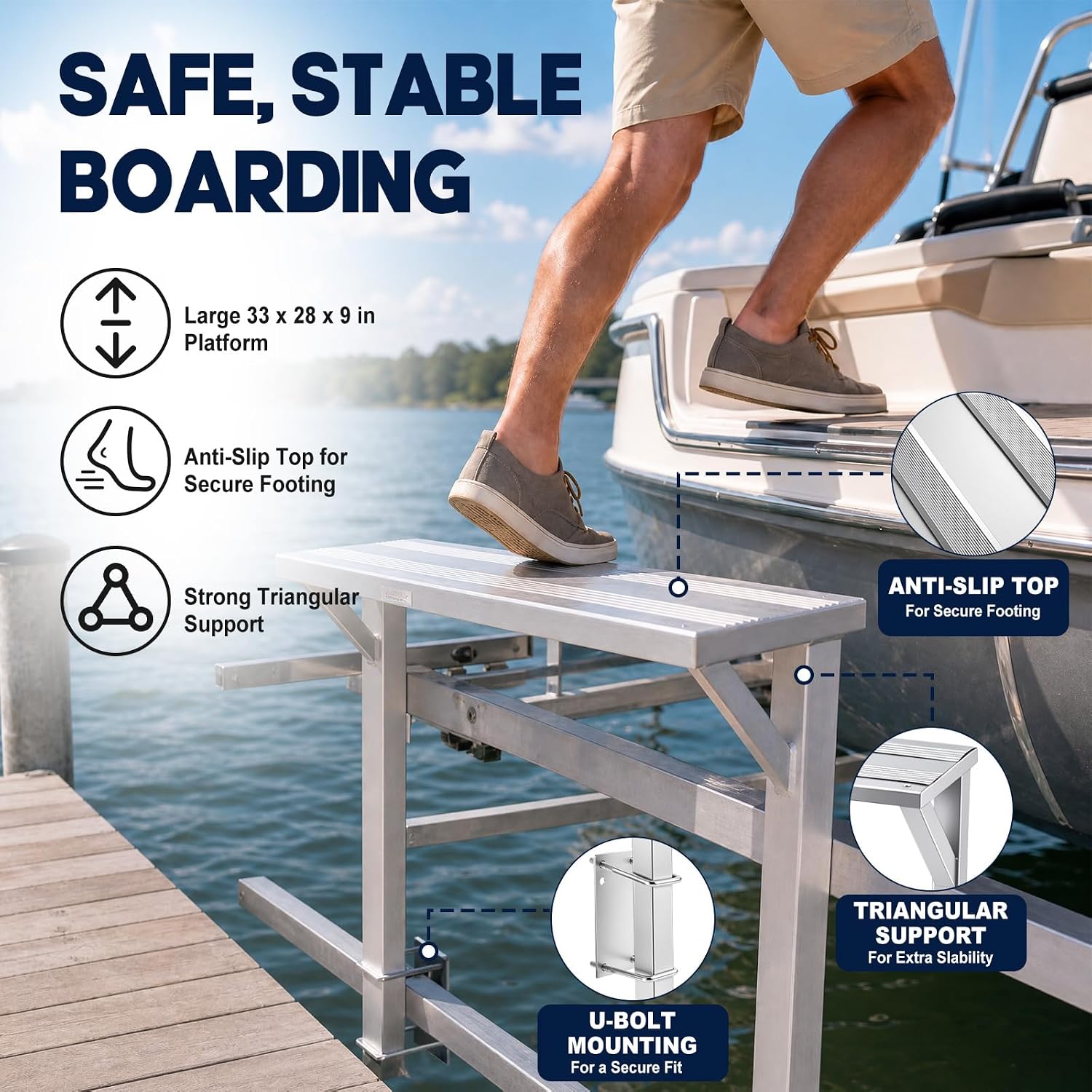
If you’ve ever watched someone try to clamber from a dock onto a boat sitting on a lift — grabbing a rail, planting a foot sideways on a gunwale, hoping for the best — you already know the problem this article is solving. A boat lift is exactly what it sounds like: a motorized or manual cradle system that raises your boat out of the water when it’s not in use, protecting the hull from fouling and corrosion. That’s great for the boat, but it creates an access problem. When the hull sits elevated above the water — often 18 to 36 inches above dock level — the standard step-aboard move disappears. You need a dedicated boarding platform (a fixed or deployable surface that bridges the gap between dock and boat) or a step-over system (a set of steps, a fold-out ladder, or a hinged platform mounted to the lift structure itself). Done right, these additions make boarding feel natural and safe. Done wrong — or skipped entirely — they’re a leading cause of preventable dock injuries. This guide walks through every major option, the specs that actually matter, and a clear decision framework based on your lift type, boat style, and budget.
| EDITOR'S PICK[Extreme Max 3006.7129 Boat Lift…](https://www.amazon.com/dp/B0CZS8FL7T?tag=greenflower20-20) | Mid-tier[VEVOR Removable Dock Ladder 5 S…](https://www.amazon.com/dp/B0GX9LYT9S?tag=greenflower20-20) | Budget pick[Wesiti Boat Lift Step-Over Plat…](https://www.amazon.com/dp/B0H116DW62?tag=greenflower20-20) | |
|---|---|---|---|
| Load capacity | — | 350 lbs | — |
| Step width | — | 4" | — |
| Slip resistant | — | ✓ | ✓ |
| Adjustable height | — | — | ✓ |
| Hardware included | — | — | ✓ |
| Price | $129.78 | $119.99 | $99.99 |
| See on Amazon → | See on Amazon → | See on Amazon → |
Why “Just Stepping Over” Isn’t Good Enough
Here’s the honest version of what happens without a purpose-built boarding solution: people improvise. They use a cooler as a step stool. They grab the bimini frame. They develop a muscle-memory routine that works fine until it doesn’t — at night, after a long day on the water, for a guest who’s visiting for the first time, or for anyone with a bad knee.
Boat U.S. Foundation’s dock safety materials consistently flag improper boarding as one of the top three causes of dock-related injury claims. The hazard compounds with boat lifts specifically because the geometry is less predictable than a boat floating in a slip. A floating boat moves with you; a lifted boat is fixed, but the gap between dock edge and gunwale can vary substantially depending on how high the lift is set and how wide the boat is.
The fix isn’t complicated or expensive — but the right fix depends on understanding what kind of lift you have and what kind of access you actually need.
By the numbers:
- Typical boat lift height above dock: 18–36 inches at gunwale
- OSHA general-industry stair riser standard (often used as a marine reference): 6.5–7.5 inches per step
- Estimated dock boarding incidents reported annually to Boat U.S. claims: thousands, with a significant share linked to lifts and elevated hulls
- Common boarding platform widths from marine suppliers: 24 to 48 inches
The Three Main Access Solutions (and When Each Makes Sense)
1. Fixed Boarding Platforms
A fixed boarding platform is a permanent or semi-permanent deck surface — usually aluminum-framed with composite or treated wood decking — that’s mounted alongside or behind the lift and creates a level walkway to the boat’s gunwale or swim platform. Think of it as a small section of dock that’s positioned specifically to match your boat’s boarding height.
When it’s the right call: If your boat stays in the same slip all season and doesn’t get pulled out regularly, a fixed platform optimized to your hull’s lifted height is the cleanest solution. You step from dock to platform, then aboard — no climbing, no improvising.
Material tradeoff: Aluminum-framed platforms with composite decking (brands like AccuDock and ShoreMaster both offer modular extensions) handle saltwater and freshwater equally well and won’t rot. Treated lumber costs less upfront but owners in Practical Sailor’s long-run corrosion reviews consistently report surface degradation within three to five seasons in humid lakeside environments, let alone coastal saltwater exposure.
Sizing logic: The platform needs to be at least as wide as your boat’s boarding point — typically 24 to 36 inches minimum. Wider is better if elderly family members or kids are regular users. Length depends on how far your lift structure sits from the dock edge; measure this before specifying, because a platform that’s 6 inches too short just recreates the gap problem.
Cost range: Entry-level fabricated aluminum platforms start around $400–$600 for a basic modular section. Integrated platforms designed to match specific floating dock systems from ShoreMaster or AccuDock run $900–$2,200 depending on size and finish.
2. Step-Over Ladders and Folding Step Systems
A step-over ladder or fold-out step system is a ladder-style or stair-style unit — typically two to four steps — mounted directly to the lift structure, the dock edge, or the boat itself. The idea is that instead of jumping or stepping across, you step up, then down (or vice versa). Some fold flat when not in use; others are fixed.
This is the most popular entry-level solution because it’s less expensive than a full boarding platform and can be retrofitted to almost any existing lift without structural modification.
Garelick and Tommy Dockside are the two brands that come up most consistently in this category in aggregated owner reviews. Garelick’s aluminum step-over ladders (their EEz-In series is well-documented) are rated for 300–400 lbs depending on model, use marine-grade aluminum construction, and run $180–$450 depending on step count and mounting configuration. Tommy Dockside’s boarding step systems occupy similar price territory but tend toward heavier-gauge aluminum with a slightly more substantial feel — owners reviewing the Tommy Dockside units on marine retailer sites frequently cite the stability under load as the differentiator versus lower-cost imports.
The folding vs. fixed tradeoff: Fixed steps are more stable and require zero action from the user; they’re always there. Folding steps require someone to deploy them, which sounds like a small ask until it’s the end of a long day and someone doesn’t bother. Power and Motoryacht’s rigging guides note that the most common failure mode of fold-out dock accessories is “non-use due to inconvenience” — meaning people stop deploying them and go back to improvising. If you’re going to spec a folding system, make sure the deployment mechanism is genuinely easy and one-handed.
Mounting considerations: Steps mounted to the lift structure work best when the lift geometry doesn’t change season to season. Steps mounted to the dock edge are more versatile but need to account for water level variation in lakes with significant seasonal fluctuation — a step that’s perfect at summer pool elevation may be awkwardly positioned at fall drawdown. This Old House’s waterfront improvement guides recommend building in 4–6 inches of adjustment range in any boarding step system installed on lakes managed for seasonal drawdown.
3. Swim Platform Step Extensions and Transom Boarding Aids
If your boat has a swim platform — that deck-like extension at the boat’s stern — and the lift raises the boat such that the swim platform is near dock level, you may not need a separate dock-side solution at all. Swim platform boarding steps or handrail extensions mounted to the transom (the boat’s vertical rear wall) can solve the access problem from the boat’s side rather than the dock’s side.
When this applies: Pontoon boats and many sterndrive cruisers with integrated swim platforms often lift to a height where the platform itself is 12–20 inches above dock level — within comfortable step-up range with a single-step boarding aid. Several manufacturers, including Garelick and Perko, make transom-mounted stainless and aluminum step brackets specifically for this use case, running $60–$180 depending on finish and load rating.
The limitation: This only works if your boarding point is the swim platform. If you board amidships (from the side, which is common on runabouts and bow-riders sitting in side-tie lifts), you need a dock-side solution — this approach doesn’t transfer.
Matching the Solution to Your Lift Type
Not all lifts behave the same way, and the access geometry changes depending on which lift category you’re working with.
Vertical 4-post cradle lifts (the most common freshwater type) raise the boat straight up. The gunwale height above the dock is fairly predictable and consistent season to season, which makes a fixed boarding platform or fixed step-over ladder a clean fit.
Cantilever lifts (common for PWCs and smaller runabouts) tip the boat at an angle during lift — the bow rises higher than the stern. Boarding a boat on a cantilever lift before it’s fully lowered is genuinely hazardous because the deck isn’t level. Any boarding solution for a cantilever lift needs to include a discipline of “fully lower before boarding” — and some dock builders add a simple painted indicator on the dock to show the safe boarding position. Boating Magazine’s lift buying guide specifically flags this as an underappreciated safety note for cantilever-style systems.
Floating dock lifts and hydraulic systems used in saltwater and tidal environments create the most variable geometry because water level changes throughout the day. Adjustable-height step systems or floating platform extensions (which rise and fall with the dock itself) are the correct answer here. A fixed-height step bolted to a stationary dock in a tidal environment will be wrong at least half the time.
The Decision Framework: If X, Then Y
If your boat is on a 4-post cradle lift in a freshwater lake with stable water levels, a fixed boarding platform or fixed step-over ladder sized to your hull’s lifted gunwale height is the cleanest, lowest-maintenance solution. Budget $300–$900 for a quality aluminum step system; budget $900–$2,200 if you want an integrated boarding platform.
If your lake has significant seasonal drawdown (4+ feet is common in managed reservoirs), spec an adjustable-height step system or plan to adjust mounting points seasonally — and build that adjustment step into your seasonal dock maintenance checklist.
If you’re on tidal or saltwater water with daily tidal variation, floating dock extensions from AccuDock or ShoreMaster that move with the water are worth the added cost. Fixed solutions in tidal environments frustrate users and eventually get ignored.
If your primary users include elderly family members, kids, or anyone with mobility considerations, prioritize handrail inclusion alongside any step system. A three-step unit with no handrail is meaningfully less safe than one with a secure grab rail — look for systems rated to 250+ lbs on the handrail itself, not just the steps.
If you’re on a tight budget and your boat has a swim platform near dock level, a simple transom-mounted boarding step from Garelick or Perko in the $80–$150 range may solve 80% of the access problem at a fraction of the cost of a full platform build.
The scramble off the dock is never worth it. The options to fix it are more accessible — in price and in installation — than most lift owners realize until they actually price them out. Start with the geometry of your lift, match the solution to who’s boarding, and spec for the worst-case user on the worst-case day. That’s the dock that works for everyone.