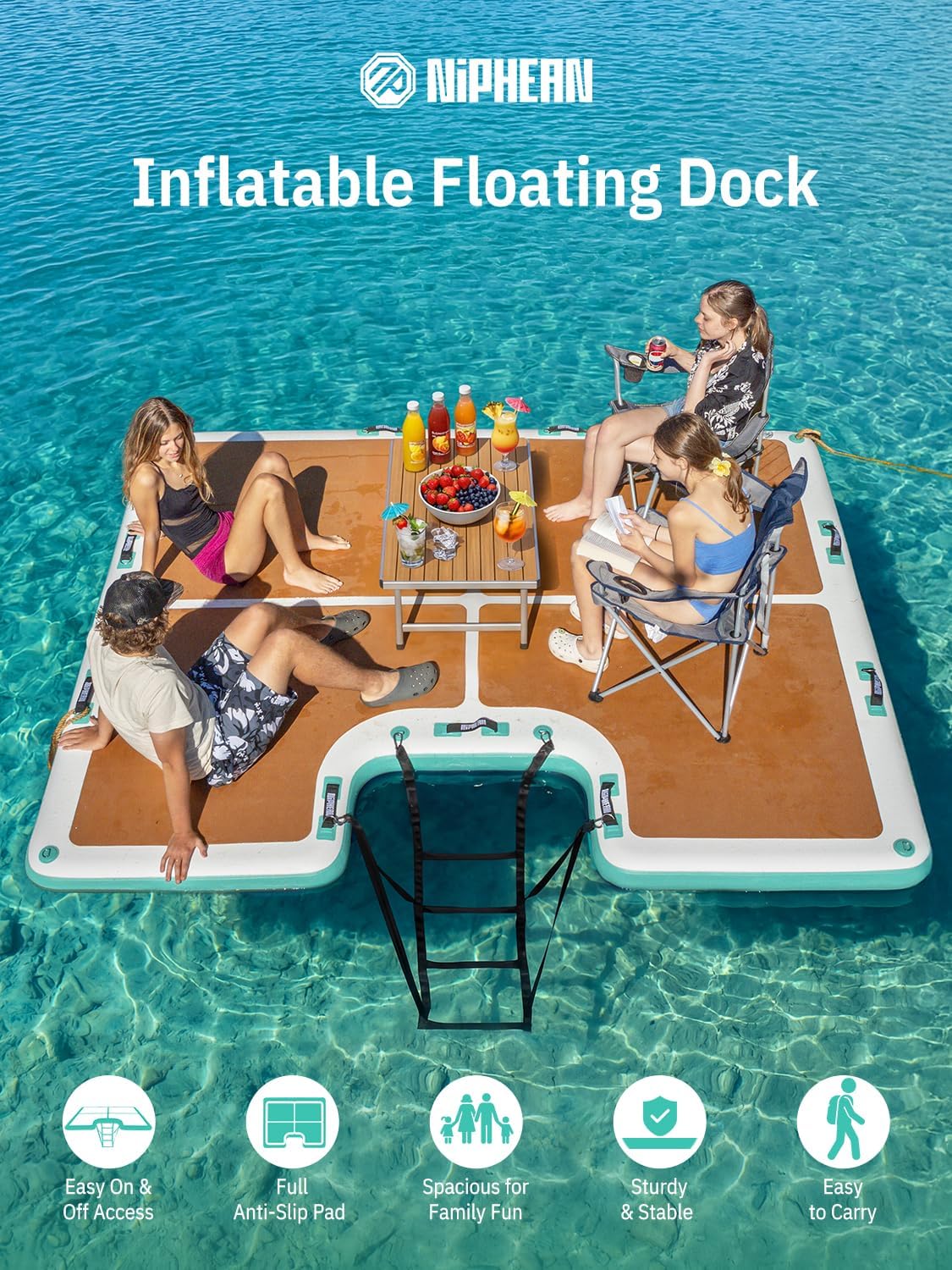
An inflatable floating dock is exactly what it sounds like: a buoyant platform made from drop-stitch PVC — the same reinforced, pressure-rated material used in high-end inflatable paddleboards — that you pump up, anchor in position, and use as a swim platform, lounging deck, or boarding station. Unlike fixed aluminum or composite docking systems, they store in a bag, require no installation permit in most jurisdictions, and cost a fraction of a permanent structure. For lake houses, rental properties, and anyone who wants a dock without the dock commitment, they’ve become genuinely compelling. But here’s the pattern that shows up across nearly every product category in this space: buyers love the platform. They’re often let down, sometimes dangerously so, by the ladder or ramp that’s supposed to get them back onto it.
This article digs into exactly that gap — using aggregated owner feedback across seven inflatable dock models to map where the failure modes live, which products buck the trend, and how to decide which dock-and-access system is actually right for your use case.
| EDITOR'S PICK[Island Hopper Patio Dock 15ft I…](https://www.amazon.com/dp/B0C679CDT4?tag=greenflower20-20) | Mid-tier[Niphean Floating Dock](https://www.amazon.com/dp/B0GQZ1SK7L?tag=greenflower20-20) | Budget pick[MoKo Inflatable Floating Dock](https://www.amazon.com/dp/B0G7GG52S4?tag=greenflower20-20) | |
|---|---|---|---|
| Capacity | 2000+ lb | — | 4-6 People |
| Ladder | — | ✓ | — |
| Handles | — | 9 | — |
| Surface | EVA Foam | Non-Slip | EVA Surface |
| Material | PVC | — | — |
| Carry Bag | — | ✓ | — |
| Price | $1,079.00 | $227.99 | $209.99 |
| See on Amazon → | See on Amazon → | See on Amazon → |
The Platform vs. Access Disconnect: What the Reviews Actually Show
Across owner feedback on the Niphean, Island Hopper Mega Yacht, Island Hopper Patio Dock, Retrospec Siesta, DOK Party-DOK, MoKo, and AWEMUFA ramp dock, the pattern is consistent enough to call a category-wide problem: the primary inflatable surface earns praise for rigidity, stability, and buoyancy. The ladder or ramp attached to it earns complaints that range from “disappointing” to “genuinely dangerous.”
The most severe report in this review pool comes from a Niphean owner who describes two rungs snapping on first use by a child weighing approximately 100 pounds. The reviewer attributes the failure to neoprene-sewn rung construction — rungs that are essentially stitched fabric panels rather than rigid structural members. This is a meaningful distinction. A neoprene-sewn rung can carry compressive load when fully inflated and properly tensioned, but it has almost no tolerance for point loading at an angle, which is exactly how a person climbing a ladder actually applies force. When the inflation pressure is even slightly below spec, or when the user’s weight shifts laterally, the rung collapses. Owners reviewing the Island Hopper Patio Dock are less alarmed but no less direct: one states flatly that “the rope ladder simply doesn’t work,” which in context reads as a ladder that provides insufficient grip and too much swing to be practically usable from deep water.
By the numbers — reported failure points across seven models:
| Failure Category | Models Affected | Severity Reported |
|---|---|---|
| Rung structural failure | Niphean | High — child injury risk |
| Rope ladder unusable in practice | Island Hopper Patio Dock | Medium — access denied |
| Air retention loss after one season | Island Hopper Mega Yacht, Retrospec Siesta | Medium — usability degraded |
| Ramp praised for dog self-rescue | MoKo, DOK Party-DOK | Positive — strong feature |
| Air retention praised over temperature range | Niphean | Positive — week-long unattended hold |
The ramp-equipped docks in this set tell a different story. MoKo and DOK Party-DOK reviewers independently highlight that large dogs — owners reporting animals in the 40–90 lb range — can self-rescue without assistance using the integrated ramp. That’s not a minor feature. A dog that can’t get back onto a platform unassisted creates a safety scenario for the human who enters the water to help. The ramp geometry on these two models is evidently gradual enough and textured enough that a motivated dog can generate the traction to climb it. Ladder rungs, inflatable or otherwise, present a fundamentally harder problem for animals and, as the Niphean data suggests, for children as well.
Air Retention: The Sleeper Variable That Defines Long-Term Value
Inflation performance splits this category in a way that doesn’t show up in spec sheets. The Island Hopper Mega Yacht and Retrospec Siesta both receive owner reports of noticeable air loss after a single season — not catastrophic deflation, but enough to affect platform rigidity and require top-offs more frequently than buyers expected. That’s a meaningful quality-of-life problem on a dock you’ve anchored 50 yards from shore.
The Niphean data point here is worth noting specifically because it represents a controlled real-world test that spec sheets can’t replicate: owners report leaving the dock anchored in a river environment for a full week, with ambient temperatures swinging from 58°F to 93°F — a 35-degree range that creates significant internal pressure variation in any inflatable. The reported outcome is no air addition required over that period. Whether that reflects superior seam construction, valve quality, or material thickness isn’t confirmed by the manufacturer’s published documentation, but the owner consistency on this point is notable.
The physics here matter for anyone making a buying decision. Drop-stitch PVC construction — two parallel fabric faces connected by thousands of vertical threads, all laminated in PVC — is inherently more airtight than a single-layer bladder because there’s no single seam running the perimeter under full tension. But valve quality is often the weak link regardless of shell construction. A high-pressure Boston valve (the standard on premium inflatables) holds better than a basic twist valve. If a product’s spec sheet doesn’t identify the valve type, that’s a flag worth investigating before purchase.
Ladder vs. Ramp: The Decision Frame
If you’re choosing between an inflatable dock with an integrated ladder and one with an integrated ramp, the owner data suggests a clear framework:
Choose ramp-equipped if: You have dogs, children under roughly 80 lbs, or any user who struggles with upper-body pulling motions. Ramps on the MoKo and DOK Party-DOK appear to deliver reliable access in real-world conditions. The AWEMUFA ramp dock also receives positive marks in this category. The trade-off is that ramps extend outward from the platform, adding anchored footprint and making storage slightly more involved.
Choose ladder-equipped only if: All users are capable adults who can tolerate a suboptimal boarding experience, and you’ve verified the rung construction isn’t neoprene-sewn fabric. Look for models where ladder rungs are either rigid (aluminum or hard plastic inserts within the inflatable structure) or where the ladder is a separate rigid component attached to the platform rather than integrated into the inflation structure itself. No inflatable ladder should be the primary access point for children or adults over 150 lbs without a specific manufacturer weight rating for that rung construction.
The hybrid approach: Several dock setups pair an inflatable platform with a separately purchased rigid swim ladder — a 3-rung stainless or aluminum unit clipped to a D-ring or anchor point on the platform edge. This adds $40–$120 to the system cost but eliminates the primary failure mode entirely. If you’re specifying an inflatable dock for a rental property or HOA-shared waterfront, this modification is worth building into the budget from the start.
Frequently Asked Questions
Can a large dog (over 60 lbs) use the ramp or ladder to get back onto an inflatable dock from deep water unassisted?
Based on aggregated owner reports, ramp-equipped models are the reliable answer here. MoKo and DOK Party-DOK reviewers specifically document dogs in the 40–90 lb range self-rescuing without human help. Ladder-equipped models are not reliably dog-friendly — the step geometry and rung spacing aren’t designed for four-legged animals, and there’s no traction surface equivalent to a ramp’s textured incline. If your dog will be in the water, prioritize a ramp dock or plan to add a separate dog-specific ramp.
How long does inflation take, and is the included hand pump adequate for a 10-foot platform?
Owner reports across this category put inflation time at 10–20 minutes for a 10-foot platform using the included manual pump — most commonly a double-action hand pump. “Adequate” is accurate but honest work: it’s enough to reach operating pressure, but it’s fatiguing, and most reviewers recommend upgrading to an electric pump (the standard SUP/inflatable board-type pump works across all these docks) if you’re inflating frequently. A 12V electric pump cuts time to 3–5 minutes. For a lake house where the dock stays inflated for weeks at a time, the hand pump is a once-per-season tool. For daily inflation/deflation, budget for the electric upgrade.
What is the typical lifespan before an inflatable dock starts losing air?
Owner data here splits by product. Island Hopper Mega Yacht and Retrospec Siesta reviewers report noticeable air retention issues after a single season. Niphean owners report solid retention through at least one full season with significant temperature variation. Industry guidance from inflatable watercraft manufacturers generally puts high-quality drop-stitch PVC platforms at 3–7 years of useful life with proper storage (dry, deflated, out of UV exposure). The primary failure modes are valve degradation and seam separation — both of which are addressable with repair kits included with most units.
Are ladder rungs on inflatable docks safe for children or adults over 150 lbs?
The honest answer based on owner reports: not reliably. The Niphean rung failure at 100 lbs in a child is the clearest data point, but it’s consistent with the structural limitations of neoprene-sewn construction. Unless a manufacturer publishes a specific per-rung weight rating and identifies rigid construction, treat integrated inflatable ladders as assist handles rather than primary load-bearing steps. For anyone over 150 lbs or for children whose weight distribution and balance are less predictable, a separate rigid ladder is the safer specification.
Can I leave an inflatable floating dock anchored unattended for multiple days?
Yes, with caveats. Niphean owners document a week-long unattended deployment in a river with 35°F temperature variation with no issues. The practical risks are anchor drag (platform migration), UV degradation from continuous sun exposure, and vandalism or debris accumulation in accessible waterways. Owners in protected coves report better outcomes than those in open-water or river-current environments. If you’re leaving a dock unattended for multiple days, check anchor holding at installation and consider a UV-protective cover if the platform will see direct sun all day.
What anchor setup actually works for keeping an inflatable dock in position on a lake?
Owner reports consistently favor multi-point anchoring over single-point. The most common functional setup is two anchors — one at each upwind or upcurrent corner — using cinder block or purpose-made mushroom anchors (8–15 lbs each) connected to the dock’s D-rings with braided polypropylene anchor lines long enough for the water depth plus 3:1 scope. Single-anchor setups allow the dock to spin and migrate, especially with any surface wind. In protected coves with soft sand bottoms, owners report that even modest 10–12 lb anchors hold adequately. In rocky or current-affected environments, heavier anchors and shorter scope reduce swing. Practical Sailor’s anchor holding guides note that scope ratio is often more important than anchor weight for soft-bottom freshwater applications.
The Bottom Line: Where to Put Your Attention Before You Buy
The inflatable floating dock category has matured enough that the platform itself is generally trustworthy across the $400–$900 price range. The surface, the buoyancy, the stability underfoot — these are mostly solved problems. The access system is not. Before committing to any specific model, the two questions that should drive the decision are: (1) who is getting back onto this dock from the water, and (2) is the rung or ramp construction engineered for that load? If the answer to the first question includes children, dogs, or adults with limited upper-body strength, the answer to the second question needs to be a ramp with textured surface, not neoprene-sewn ladder rungs. Plan the anchor system before the dock arrives, not after. And if air retention matters — which it does for any deployment longer than a day trip — weight the owner longevity reports heavily, because spec sheets don’t tell you what happens after season one.