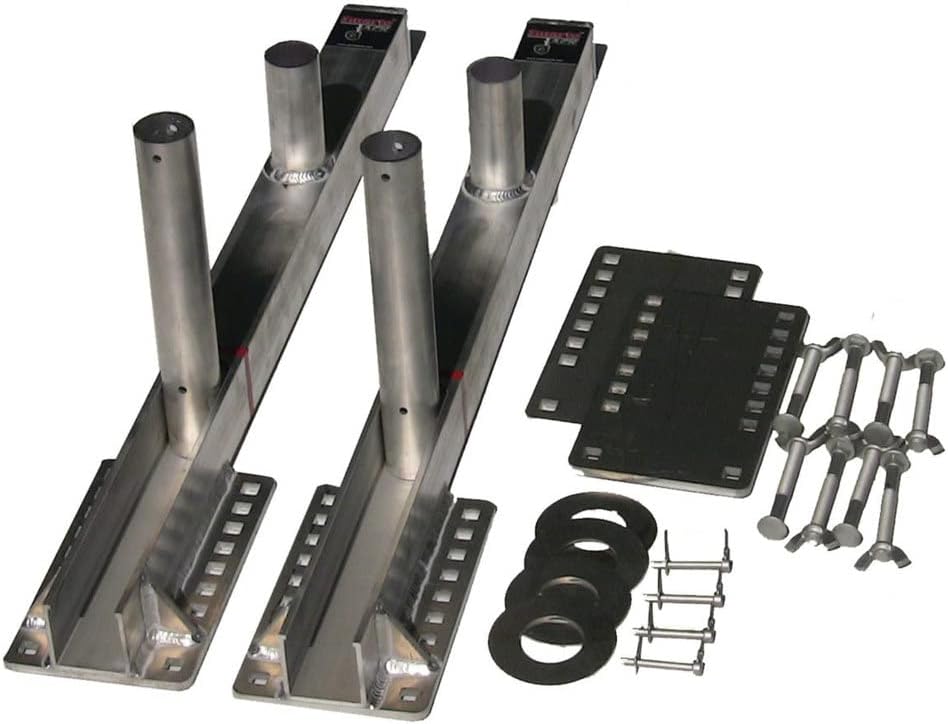
A boat lift is exactly what it sounds like — a mechanical frame, usually made of aluminum or galvanized steel, that raises your boat out of the water when it’s not in use, protecting the hull from fouling, waterline staining, and prolonged submersion. Most lifts roll in and out of the water on wheels or slide along a fixed track. That sounds straightforward until you actually try to move one at the start or end of the season. A fully rigged pontoon lift can weigh several hundred pounds before you even account for the bunk boards, cables, and motor. Getting it in and out of the water by hand — especially solo — is how people get hurt. This guide walks through four products that each solve a different piece of that problem: Smarte Jacks, the Extreme Max 24-inch roll-in wheel, the Metlead aluminum wheel kit, and the Extreme Max Boat Lift Buddy. If you have a seasonal install or removal coming up, or you’re building out a new lift setup and want to spec it right from the start, here’s how the tools compare and which one belongs in your situation.
| EDITOR'S PICK[Extreme Max 3006.4553 Boat Lift…](https://www.amazon.com/dp/B0D2LYVD15?tag=greenflower20-20) | Mid-tier[Quality Mark 28199 Smarte Jack…](https://www.amazon.com/dp/B002IV4Y4M?tag=greenflower20-20) | Budget pick[Extreme Max 3005.3729 Heavy-Dut…](https://www.amazon.com/dp/B010N3A6OI?tag=greenflower20-20) | |
|---|---|---|---|
| Type | Wheel drive | Jack | Wheel |
| Voltage | 120V | — | — |
| Material | — | — | Plastic |
| Wheel size | — | — | 24" |
| Pair? | — | ✓ | — |
| Price | $875.00 | $413.70 | $49.32 |
| See on Amazon → | See on Amazon → | See on Amazon → |
The Four-Part Problem Every Lift Owner Faces
Moving a boat lift isn’t one problem — it’s four sequential problems, and different products solve different ones. Understanding the sequence is the fastest way to figure out what you actually need.
1. Getting the lift off the bottom. Before anything rolls, the frame has to be lifted clear of the lake or river bottom. On soft-bottomed lakes especially, wheel feet can sink several inches over a season, and that suction load is where most injuries happen.
2. Rolling it in or out of the water. Once it’s mobile, the lift has to travel the transition zone between shore and open water — often over uneven bottom, sand, or rock.
3. Raising and lowering the boat under load. Once the lift is positioned, the drive mechanism (usually a motor turning a cable drum) does the vertical work.
4. Maintaining that drive system over seasons. Wheels, rubber contact surfaces, and shaft hardware degrade in wet environments. Replacement and fitment compatibility matter here.
Each product in this guide addresses one or two of those phases. None of them does all four.
Smarte Jacks: The Injury-Prevention Case
Smarte Jacks are hydraulic-style lift assist tools — you position one under each side of the lift frame and pump them up, raising the frame off the bottom before you start rolling. The pitch is simple: remove the dead-lift moment entirely.
Reviewer sentiment on this product is notably consistent, and unusually emphatic. The phrase that comes up repeatedly is some version of “worth every penny compared to throwing your back out.” That’s not hyperbole for most lift owners — it’s a genuine cost-benefit statement. A pair of Smarte Jacks represents a fraction of what a single ER visit or a week of lost work costs. Reviewers who manage pontoon lifts solo — a setup that’s heavy, wide, and awkward — describe the product as making single-person seasonal installs and removals genuinely achievable rather than technically possible but practically punishing.
The functional logic is sound. By distributing the lift force across a mechanical device rather than human lumbar, you convert a high-injury-risk maneuver into a controlled one. That’s the same principle This Old House covers in its guides on moving heavy objects: introduce a mechanical advantage before the load moves, not after you’ve already strained to get it started.
One honest caveat: Smarte Jacks solve the getting-it-off-the-bottom phase. They don’t replace a wheel system for rolling, and they don’t help with the drive motor. If your lift’s feet are stuck in soft sediment, you’ll still need to break that suction — Smarte Jacks help, but they’re not magic on a seriously sunken frame.
Extreme Max 24-Inch Roll-In Wheel: Fitment Details Matter
The Extreme Max 24-inch replacement roll-in wheel addresses Phase 2 — the rolling transition. Roll-in wheels are what allow a lift frame to travel from shore into the water and back; they’re essentially large-diameter wheels mounted on a cross-shaft that span the lift’s rear (or front) frame legs.
Reviewers are generally positive on this product, but one flagged a detail worth knowing before you order: the replacement wheel runs slightly narrower than some OEM configurations, leaving measurable shaft play between the inner and outer washers. The reviewer’s framing was clear — this is a precision concern, not a functional failure. The wheel still rolls and carries load. But if you’re someone who notices slop in the fit and it bothers you, or if your lift frame was spec’d tight from the factory, that gap is worth knowing about before the product arrives.
The shaft diameter compatibility question is the bigger issue for most buyers. Not all roll-in wheels fit all lift frames. Extreme Max publishes shaft diameter specs for this wheel, and the verification step is straightforward: measure your existing shaft diameter with a caliper before ordering. If you’re replacing a worn or damaged wheel, the OEM part number from your lift manufacturer is always the cleanest path, but third-party replacements like this one are a legitimate option when OEM parts are backordered or discontinued — which, per Power & Motoryacht’s coverage of lift hardware availability, happens more often than it should on older lift models.
Extreme Max Boat Lift Buddy: Power-Assisted Raising and Lowering
The Boat Lift Buddy is a motorized drive wheel that replaces or supplements the manual crank on a boat lift’s cable drum. You mount it, engage the rubber drive wheel against the drum shaft, and the motor does the work of raising or lowering the lift under load.
Reviewers handling serious loads — one specifically documented a 5,500-pound deck boat — report that the Buddy handles the weight reliably. That’s a meaningful data point, because most lift accessories are spec’d conservatively and real-world loaded performance is always the question.
The durability nuance is more interesting. At least one reviewer disengages the rubber drive wheel during the lowering cycle specifically to prevent premature wear. That behavioral detail tells you something important about how to think about this product: the rubber contact surface is a consumable, not a permanent component. How long it lasts depends heavily on how you use it. Lowering a loaded lift under power puts the wheel under continuous friction load in one direction; if you treat that rubber as infinitely durable and run every cycle at full engagement, you’ll wear it faster than if you’re selective about when you engage.
Boating Magazine’s lift hardware coverage notes that motorized assist systems across the category generally share this characteristic — the drive interface is the wear point, and replacement availability matters as much as initial quality. Before buying, confirm that replacement rubber drive wheels for the Boat Lift Buddy are available as a standalone part.
By the Numbers
| Product | Phase Addressed | Key Spec | Notable Reviewer Flag |
|---|---|---|---|
| Smarte Jacks (pair) | Lift off bottom | Hydraulic assist, pair | Solo pontoon install viable |
| Extreme Max 24” wheel | Roll-in/out | 24” diameter, shaft-dependent | Slightly narrower than some OEM |
| Boat Lift Buddy | Raise/lower under load | Motor-driven, rubber wheel | Rubber wheel is consumable |
| Metlead aluminum wheel kit | Roll-in/out + corrosion | Aluminum construction | Corrosion resistance in wet use |
Metlead Aluminum Wheel Kit: The Corrosion-Resistance Option
The Metlead aluminum wheel kit earns shorter but consistently positive reviews, and the pattern is specific: buyers who care about long-term corrosion resistance in wet environments are satisfied. Practical Sailor’s ongoing coverage of dock hardware corrosion makes the case clearly — aluminum outperforms galvanized steel in sustained freshwater submersion, and the gap widens significantly in any brackish or mineral-heavy lake environment.
The reviewer praise here isn’t effusive about performance features so much as it is about the product doing exactly what it’s supposed to do over time without degrading. For a wheel kit that lives at the waterline, that’s the right thing to optimize for. The mounting plate strength question (addressed in the FAQ below) is the one area where buyers on soft-bottomed lakes should do the math before committing.
Decision Framework: If X, Then Y
You’re looking at real money across these products, and the right answer depends almost entirely on which phase of the lift-moving problem is your actual bottleneck.
If your main problem is injury risk or solo operation: Smarte Jacks are the starting point. Address Phase 1 before you worry about anything else.
If your main problem is a worn or broken roll-in wheel: Measure your shaft diameter first. If the Extreme Max 24” wheel matches your shaft spec and the slight fitment variance doesn’t concern you, it’s a solid replacement. If you’re in a corrosive or mineral-heavy water environment, the Metlead aluminum kit is worth the comparison.
If your main problem is the effort and risk of raising and lowering a heavy boat: The Boat Lift Buddy solves that problem well up to serious loads, but go in knowing the rubber wheel is a wear item and plan accordingly.
If you’re building out a new lift setup from scratch: Spec the Smarte Jacks and an aluminum wheel kit together as your baseline, then evaluate whether a powered assist makes sense for your boat’s weight class.
Frequently Asked Questions
Can one person use Smarte Jacks alone to install or remove a pontoon lift, or is a helper required?
Reviewer accounts consistently describe solo operation as viable with Smarte Jacks — that’s one of the product’s explicit selling points. The jacks handle the lift-off phase, which is normally the moment that requires a second person or causes injury. You still need to guide the frame once it’s mobile, which is easier solo on a calm day with good footing. On an uneven bottom or in any current, a second person is still worth having for the rolling phase even if the jacking is solo-manageable.
Will the Extreme Max 24-inch wheel fit my specific lift frame, and how do I verify shaft diameter compatibility before ordering?
Measure your existing cross-shaft diameter with a caliper — don’t estimate from the old wheel’s bore, which may have worn. Compare that measurement to the Extreme Max published spec for this wheel. If the numbers match, it’ll fit. The reviewer-noted fitment variance is about width, not bore diameter, so as long as your shaft length accommodates some washer play, function is unaffected.
Is the Boat Lift Buddy motor safe to use for both raising and lowering a loaded boat lift?
Based on reviewer accounts at loads up to 5,500 pounds, the motor handles both directions. The usage nuance is that at least one experienced user disengages the rubber drive wheel during lowering specifically to manage wear — not because lowering is unsafe, but because continuous friction in that direction degrades the rubber faster.
How long does the rubber drive wheel on the Boat Lift Buddy last before it loses grip?
There’s no manufacturer-published cycle count, and reviewer longevity data varies with usage patterns. Treat it as a consumable and confirm replacement wheel availability before your first season of heavy use. Users who disengage during lowering report longer service life.
Are aluminum wheel kit mounting plates strong enough for a fully loaded lift on a soft lake bottom?
Aluminum mounting plates are structurally rated for lift loads, but the soft-bottom concern is about sinking and lateral stability rather than plate strength. On very soft silt or muck bottoms, wider footprint pads or float boards under the wheel frame are the right mitigation — not a different wheel material.
Do Smarte Jacks work on lift designs other than pontoon lifts?
Reviewers primarily document pontoon lift use, which reflects where the product is most heavily marketed. The mechanical principle — hydraulic lift assist under a frame rail — applies to any lift with accessible frame points that accept the jack head. Cradle-style and four-post lifts with accessible bottom frame rails are generally compatible; jet ski and PWC cradle lifts with narrower frames may require checking jack head clearance against your specific frame geometry.